Top Legal Websites to Read Free Online Books
Discover the best legal websites to read free online books. A comprehensive guide to platforms with thousands of free titles and how AI is changing the world of reading.
Stay updated with our newsletter
Receive exclusive tips, resources, and updates to turn your ideas into bestselling books.
It was a particularly cold November evening when Sarah, a college student on a tight budget, found herself staring at a list of over twenty books she needed to read for her exams. With a sigh, she looked at the prices: over $500 just for required textbooks. But while sipping her hot tea, she typed "free online books" into Google and discovered a world she never imagined: digital libraries overflowing with literary masterpieces, timeless classics, and modern works, all completely free and most importantly, legal. That evening, Sarah not only found the books she needed but opened the door to a universe of unlimited reading.
If you're also searching for free online books, you're in the right place. In this comprehensive guide, we'll show you the best legal websites where you can access thousands of titles without spending a penny, respecting copyright and supporting digital reading culture.
Table of Contents
- Why choose legal free online books
- Best international platforms for free books
- Digital libraries and digital lending
- Public domain books: a hidden treasure
- Academic and specialized resources
- How AI lets you read the book you want
- Tips for digital reading
- Frequently asked questions (FAQ)
Why choose legal free online books
The search for free online books is one of the most popular queries on the web, but it's crucial to distinguish between legal and illegal sources. Choosing authorized platforms doesn't just mean respecting the law, but also supporting authors and publishers who make the creation of new works possible.
Legal websites offer numerous advantages over questionable alternatives. First and foremost, they guarantee safe files free from malware, a real risk when downloading content from unverified sources. Many people don't consider that pirated files can contain viruses, trojans, or spyware that compromise the security of their device and personal data.
Legal platforms also offer a superior reading experience. Files are optimized for different devices, from smartphone reading to tablets and e-readers. Formatting is carefully done, covers are in high resolution, and often additional features like bookmarks, notes, and cross-device synchronization are available.
Another important aspect concerns content variety. Contrary to what you might think, legal websites don't only offer dusty old classics. Many platforms include contemporary works whose authors have chosen to distribute them for free, temporary publisher promotions, free anthologies, and works by emerging authors seeking visibility. This means you can discover new literary talents and genres you might never have considered.
From an ethical standpoint, using legal sources means respecting authors' work. Writing a book requires months or years of commitment, research, and dedication. Even when a work is free to the reader, it's often the result of agreements with libraries, institutions, or reading promotion programs that still recognize value in creative work.
Legal platforms also provide better support and reliability. You can create accounts, sync your reading progress across devices, receive personalized recommendations, and access customer support if you encounter problems. These services are impossible to find on illegal sites that could disappear overnight.
Best international platforms for free books
Expanding your search for free online books to international platforms opens doors to millions of titles in various languages, predominantly English but also with significant collections in French, Spanish, German, and other languages.
Open Library is an Internet Archive initiative that aims to create "one web page for every book ever published." This ambitious goal is materializing with over 20 million bibliographic records. Open Library's unique feature is the digital lending system: just like in a physical library, you can borrow ebooks of works still under copyright for a limited period of 14 days. The catalog includes both freely downloadable public domain works and modern titles available through lending. The interface allows you to create personalized reading lists, write reviews, and track books you've read. It's an exceptional resource for those seeking both classics and contemporary works.
ManyBooks offers over 50,000 free ebooks with a modern, user-friendly interface. The platform stands out for its excellent search and recommendation system: you can filter books by genre, language, length, popularity, and even by "mood" or specific themes. Beyond public domain classics, ManyBooks includes works by contemporary authors who have chosen to distribute their work for free. The platform supports numerous formats, specifically optimized for different devices. Each book has a detailed page with synopsis, user reviews, and suggestions for similar readings. No registration is required to download books, although creating an account allows you to save favorites and personalized lists.
Smashwords is a self-publishing distribution platform that also hosts a vast section of free ebooks. Independent authors can publish their works and choose to offer them for free or for a fee. The free collection exceeds 90,000 titles, with new additions daily. Here you can discover talented emerging authors seeking to build their audience. Genres range from romance to science fiction, thriller to fantasy, non-fiction to practical guides. Quality varies, but the review and rating system helps identify hidden gems.
Standard Ebooks takes a different approach: they take public domain works and produce exceptionally high-quality editions. Each ebook is carefully formatted with modern typography, professional covers, and detailed metadata. The collection is smaller than other platforms (around 600 titles), but each book is a jewel of digital publishing. If you appreciate attention to detail and want the best possible reading experience for classics, Standard Ebooks is the place for you.
Feedbooks offers both public domain classics and original free works from contemporary authors. The public domain section includes over 7,000 carefully curated titles. What makes Feedbooks special is the clean, elegant interface and books optimized for all major e-readers. The platform also has an "Original Books" section where independent authors can publish their works for free, offering readers access to new and diverse voices.
Digital libraries and digital lending
The concept of libraries has evolved in the digital age, maintaining the mission to democratize access to culture while adapting to new technologies. Digital libraries and digital lending systems represent an excellent way to access free online books, including new releases and bestsellers.
OverDrive/Libby is the most widely used platform internationally for library digital lending. Libby is the user-friendly mobile app that accesses the OverDrive catalog of over 40,000 libraries worldwide. If you have access to a library (whether public, academic, or through special membership programs), you can use this app to borrow ebooks and audiobooks. The interface is sleek and intuitive: search for a title, borrow it with a tap, and start reading immediately. If a book you want is already on loan to other users, you can join the waitlist and receive a notification when it becomes available. Another interesting feature is the automatic "tag": if you're about to finish the lending period and haven't completed the book, the app notifies you a few days in advance, allowing you to renew the loan if no one else is waiting.
The lending system works with DRM (Digital Rights Management) technology: you download the book for a determined period, after which the file automatically deactivates, just like returning a physical book. There are no delays or fines: simply the book will no longer be readable. This system allows libraries to offer even new releases and bestsellers, with a limited number of concurrent copies on loan.
Hoopla is another popular digital library platform in the United States and Canada. Unlike OverDrive, Hoopla works with an "instant availability" model: when you borrow a book, it's immediately available without waitlists. Each library sets a monthly limit on the number of items you can borrow (typically 5-10 per month). Beyond ebooks, Hoopla offers audiobooks, comics, movies, TV series, and music. It's a complete multimedia entertainment platform accessible with your library card.
Internet Archive deserves special mention. Beyond being a digital archive of websites, it includes a library with over 4 million digitized books. Many are available for free download, while others can be digitally borrowed. The Controlled Digital Lending project allows access to works still under copyright by maintaining a 1:1 ratio with physical copies owned: for each physical copy in the archive, one digital loan at a time is granted. This innovative approach expands access to books that would otherwise be unavailable in digital format.
University libraries often offer free access to students and researchers. Many universities have subscriptions to platforms like JSTOR, Project MUSE, or SpringerLink that include not only academic articles but also complete books. If you're a student or work in academia, it's worth exploring your institution's digital resources: you probably have access to thousands of specialized texts and also general interest works you never thought you'd find.
Public libraries are increasingly investing in digital services. Many offer not only ebook lending but also access to online courses, language learning platforms, streaming services for documentaries and cultural content, and digital newspapers and magazines. A single library card can open doors to an incredible wealth of cultural resources, all completely free.
Public domain books: a hidden treasure
The concept of public domain is fundamental to understanding why so many free online books are legally accessible. A work enters the public domain when copyright expires, allowing anyone to use, copy, distribute, and even modify it freely.
In the United States, copyright rules are complex but generally works published before 1928 are in the public domain. For works published between 1928 and 1977, various factors determine public domain status. The European Union has different rules, with copyright lasting the author's lifetime plus 70 years after death.
Public domain doesn't mean just "dusty old classics." It means free access to immortal masterpieces that have shaped Western and world culture. You can freely read all the works of Shakespeare, Cervantes, Goethe, Tolstoy, Dostoevsky, Kafka, Proust, and hundreds of other literary giants. These are books still studied in universities today, analyzed by experts, cited in public discourse, and loved by readers of all ages.
Public domain also includes fundamental scientific and philosophical essays. Want to read Darwin's "On the Origin of Species"? It's free. Adam Smith's "The Wealth of Nations"? Free. The works of Plato, Aristotle, Machiavelli, Descartes, Kant, Nietzsche? All available for free. This is knowledge that formed modern thought and you can explore it without limits.
A fascinating aspect is that many public domain works have received new modern translations. While the original text is free, new translations may be protected by copyright, but publishers often offer free versions with older but still excellent translations. For example, you can find various translations of Russian or Greek classics, each with its own interpretive nuances.
Public domain continues to expand every year. On January 1, 2025, for example, all works published in 1924 entered the public domain in the United States. This ongoing process means the public domain library grows constantly, adding new voices year after year. It's exciting to think that works we consider "modern" will gradually become freely accessible to everyone.
Beyond literature, public domain includes sheet music, historical photographs, scientific illustrations, maps, and much more. These resources are invaluable for students, researchers, educators, and creatives who can use them in their projects without worrying about copyright restrictions.
Academic and specialized resources
The world of free online books extends far beyond popular literature into specialized and academic fields. Numerous platforms offer free access to scholarly works, research papers, technical manuals, and specialized publications.
Google Scholar isn't just for academic papers; many complete books are available for free reading or download. By searching for topics of interest, you'll often find entire chapters or complete books legally accessible. Publishers sometimes make older editions available for free while selling current ones, providing access to solid foundational knowledge even if not the latest edition.
JSTOR has opened a significant portion of its catalog for free reading. While you need institutional access to download PDFs, you can read up to 100 articles per month online for free after creating a free account. Many complete books are included in this program, especially in humanities, social sciences, and history. It's an invaluable resource for anyone conducting serious research or wanting to deepen understanding of complex topics.
CORE (COnnecting REpositories) aggregates open access research papers and books from thousands of repositories worldwide. With over 200 million free scholarly articles and millions of books, it's one of the largest open access resources. The advanced search allows filtering by topic, publication date, type of content, and relevance. It's particularly useful for finding recent research and cutting-edge academic work.
arXiv is the primary repository for preprints in physics, mathematics, computer science, quantitative biology, quantitative finance, and statistics. While primarily focused on research papers, many extended works and monographs are also available. If you're interested in STEM fields, arXiv provides access to cutting-edge research often months or years before official publication.
OpenStax offers free, peer-reviewed college textbooks. Created by Rice University, this project aims to make quality education accessible to everyone. The catalog includes textbooks for introductory courses in mathematics, sciences, social sciences, and humanities. Each book is available in free PDF format, can be read online, or purchased in print at low cost. For students, this can represent savings of hundreds or thousands of dollars on textbook costs.
Directory of Open Access Books (DOAB) catalogs over 50,000 academic books from over 400 publishers, all available in open access. Coverage spans all disciplines, with particularly strong collections in humanities and social sciences. Each book has undergone peer review, ensuring academic quality. It's an essential resource for researchers and students seeking reliable academic sources.
How AI lets you read the book you want
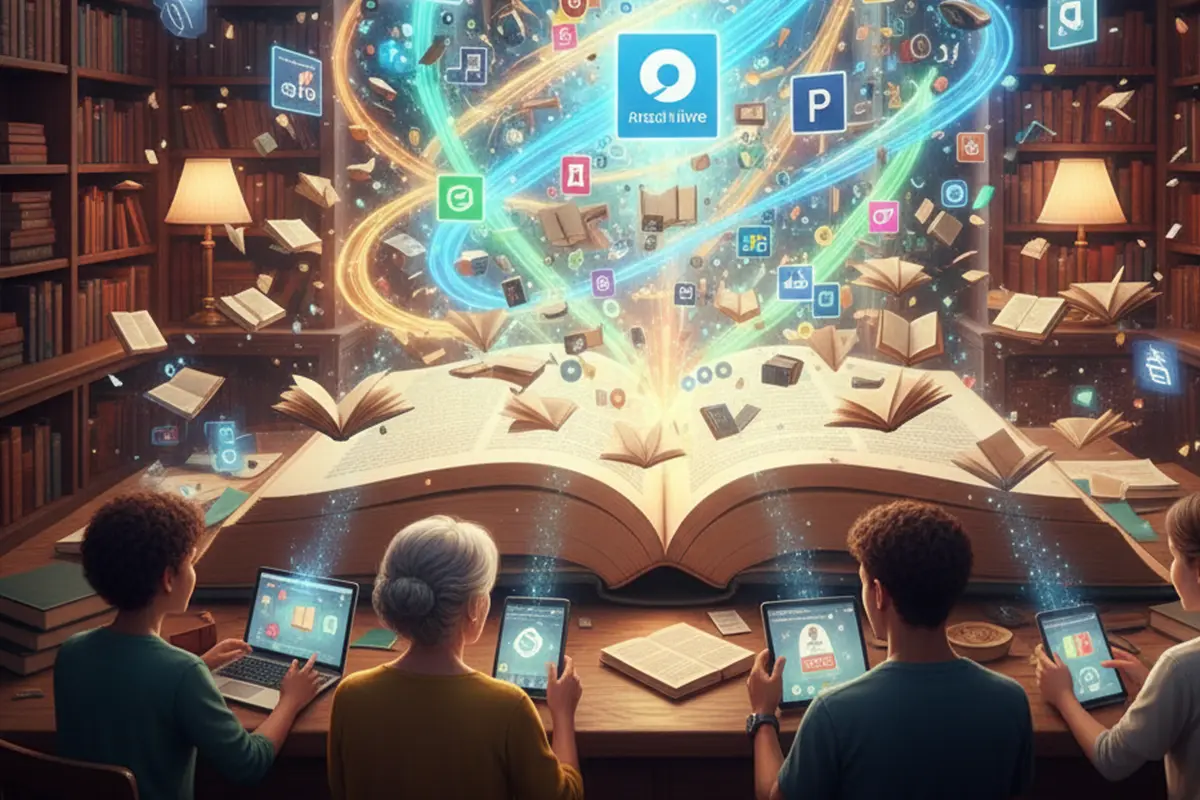
Beyond websites offering free online books to read, artificial intelligence has opened a completely new frontier: the ability to create and read the book you've always wanted but that was never written. This revolution is radically changing the relationship between readers and literary content.
Have you ever wanted a mystery novel set in your hometown, with characters resembling people you know? Or a practical guide on an extremely specific topic that no traditional publisher would consider commercially viable? Or perhaps a children's story personalized with your child's name and their favorite toys as protagonists?
Generative artificial intelligence, powered by advanced language models, makes all this possible. Platforms like Books Maker have democratized the literary creation process, allowing anyone to transform an idea into a complete, professional book. You don't need to be an expert writer or have particular technical skills: you just need a clear idea of what you want to read.
The process is surprisingly simple and intuitive. First, you define your book's concept: genre, setting, main characters, basic plot, or topic if it's non-fiction. The more details you provide, the more the result will align with your vision. The AI analyzes your directions and generates a narrative structure or detailed outline. At this point, you can review and modify this structure, adding or removing chapters, changing the order of events, specifying certain passages better.
Once you approve the structure, the AI generates the complete content chapter by chapter. You can read each section as it's created and request specific modifications: change the tone, expand a description, add more dialogue, modify the narrative point of view. It's a collaborative process where you maintain creative control while the AI handles the technical writing aspects.
The result is a unique book, created specifically for you, that you can read immediately or export to standard formats like EPUB or PDF to read on your preferred device. Some users even create printed physical versions of their personalized book.
This technology is particularly powerful for specific educational purposes. A teacher can create didactic material perfectly calibrated to their students' level, including examples relevant to their context. A professional can generate detailed operational guides for specific business processes. A parent can create stories that address particular situations their child is experiencing, making reading a personalized therapeutic and educational tool.
The quality of AI-generated texts has improved dramatically in recent years. While early experiments produced rigid and repetitive texts, current technologies generate fluid prose, with coherent narrative development, three-dimensional characters, and even defined literary style. Of course, quality also depends on the quality of directions provided: the more precise and detailed your requests, the better the result.
An interesting aspect is that AI also allows exploring variants of classics or continuing stories that remained unfinished. Want to read an alternative version of "Romeo and Juliet" with a happy ending? Or imagine what would have happened to your favorite novel's characters after the book's conclusion? AI can generate these literary "what ifs," offering new perspectives on familiar stories.
This democratization of literary creation doesn't replace human authors but enormously expands possibilities for readers. You can continue enjoying masterpieces of classical and contemporary literature while simultaneously accessing ultra-personalized content that no traditional publisher could ever offer on a mass scale.
AI is also revolutionizing how we discover books. Recommendation algorithms are becoming increasingly sophisticated, analyzing not just what you've read but how you engage with content, what passages you highlight, where you slow down or speed up reading. This creates deeply personalized recommendations that often introduce you to books you would never have found through traditional searches.
Tips for digital reading
Reading free online books in digital format offers unique advantages over traditional paper reading, but also requires some adjustments to optimize the experience and protect your visual health.
Device choice significantly influences reading experience. Dedicated e-readers like Kindle, Kobo, or PocketBook use e-ink technology that simulates printed paper appearance, reducing visual fatigue. These devices are specifically optimized for reading: long-lasting battery (weeks on a single charge), screen readable even in direct sunlight, reduced weight for extended reading. If you read a lot, investing in an e-reader quickly pays off in comfort.
Tablets offer greater versatility: you can read books, browse the web, watch videos, and use different apps. Color screens are ideal for comics, illustrated books, and magazines. However, backlit screens can strain eyes during extended reading sessions, especially in the evening. If you use a tablet for reading, activate night mode or the blue light filter to reduce exposure to blue light that can interfere with sleep.
Smartphones have also become popular reading devices, perfect for reading during commutes or in spare moments of the day. Modern reading apps adapt well to small screens, allowing adjustment of text size, line spacing, and margins. The main advantage is portability: you always have your library in your pocket.
Reading apps make the difference. Kindle, Kobo Books, Google Play Books, and Apple Books offer advanced features like cross-device synchronization, integrated dictionaries, highlighting and notes, reading statistics, and personalized recommendations. Many also allow importing EPUB or PDF files downloaded from other sources. Apps like Moon+ Reader or FBReader are particularly appreciated for advanced reading experience customization.
Lighting is crucial for comfortable digital reading. In natural light conditions, reduce screen brightness to a level that appears sharp but not glaring. In the evening, increase it slightly but also maintain adequate ambient lighting: reading in a completely dark room with only the illuminated screen greatly strains the eyes. E-readers with integrated warm backlighting are ideal for nighttime reading.
Organize your digital library methodically. Create collections or virtual shelves by genre, reading priority, or themes. Use tags to catalog books in ways that make sense to you. Many readers create separate lists for "to read," "in progress," "read," and "favorites." Keep your reading progress synced across devices using cloud services or apps with sync functionality.
The 20-20-20 rule helps prevent digital visual fatigue: every 20 minutes of reading, look at something at least 20 feet (about 6 meters) away for at least 20 seconds. This allows eye muscles to relax. Also remember to blink frequently: when we're focused on a screen, we tend to blink much less than normal, causing eye dryness.
Consider text-to-speech functionality for times when you can't actively read. Many e-readers and reading apps can read text aloud, allowing you to "read" while driving, cooking, exercising, or doing household chores. While not replacing the experience of active reading, it's a great way to consume more content.
Frequently asked questions (FAQ)
Is it legal to download free online books?
Yes, it's perfectly legal to download free online books from the authorized platforms we've listed in this guide. Public domain works can be freely downloaded and distributed. For titles still under copyright, library digital lending systems operate with regular licenses. Just avoid websites that illegally offer pirated books still covered by copyright.
Which ebook formats are best?
The most common formats are EPUB (universal, compatible with most devices except Kindle), MOBI/AZW (specific to Kindle), and PDF (maintains original layout but less flexible for reading on small screens). EPUB is generally the most versatile and allows adjusting text size, font, and spacing.
Can I read free online books on Kindle?
Yes, several options exist. You can convert EPUB files to Kindle format using free software like Calibre. Additionally, Amazon Kindle Store has a section dedicated to free ebooks with thousands of titles.
How does library digital lending work?
Digital lending works like traditional lending: you search for a title in the library's digital catalog, borrow it for a determined period (usually 14-21 days), and read it on any device using the platform's app. When the loan expires, the file automatically deactivates without need to manually return it. If you want to keep the book longer, you can renew the loan if no other user is waiting.
Do public domain books have modern translations?
Many public domain classics have received new translations over the years. While the original text is copyright-free, recent translations may be protected. However, excellent decades-old translations exist that are still high quality and completely free. For original English texts, naturally, no translation is needed.
Can I print books downloaded for free?
For public domain works, yes, you can freely print them. For books on digital loan or with DRM protection, it's generally not permitted or technically impossible. Always check the specific terms of use for the platform you're downloading from.
How can I create a personalized book with AI?
You can use platforms like Books Maker that integrate artificial intelligence for content generation. The process involves defining the genre, plot or topic, specifying characters and setting, and letting AI generate the complete content. You can then review, modify, and refine the text until you get exactly the book you want to read. It's a revolutionary way to access unique stories created specifically for you.
Do free ebooks have the same quality as paid books?
For public domain literary classics, content quality is identical: you're reading the same immortal masterpieces. The difference might be in formatting or presence of critical introductions. For contemporary authors' works offered for free, quality varies: some are excellent and made free for promotional reasons, others might be less polished works by beginning authors.
About Books Maker: Our team is made up of AI professionals. Together with expert writers and authors, we created booksmaker.ai to help our users achieve their publishing dreams by leveraging the power of Artificial Intelligence tools for every stage of the process, from idea to book creation.
Related Articles
If you enjoyed this article about free online books, you might also be interested in:
-
How to Create a Digital Book: Complete 2025 Guide - Learn how to transform your ideas into a professional ebook using AI tools, formatting techniques, and publishing strategies.
-
Write Free Books You Would Like to Read - Use artificial intelligence to create personalized books with the characters and plots you desire, completely free.
-
AI Book Maker: Create High-Quality Books with AI - A comprehensive guide on how to use AI to write, structure, and publish your book quickly and effectively.
📌 Have more questions? Check out our complete FAQ on how to create books with Books Maker to find all the answers about features, pricing, publishing, and more.
Share this article
Start creating your book with AI
Join thousands of authors who are already using Booksmaker.ai to turn their ideas into published books.
Start for free