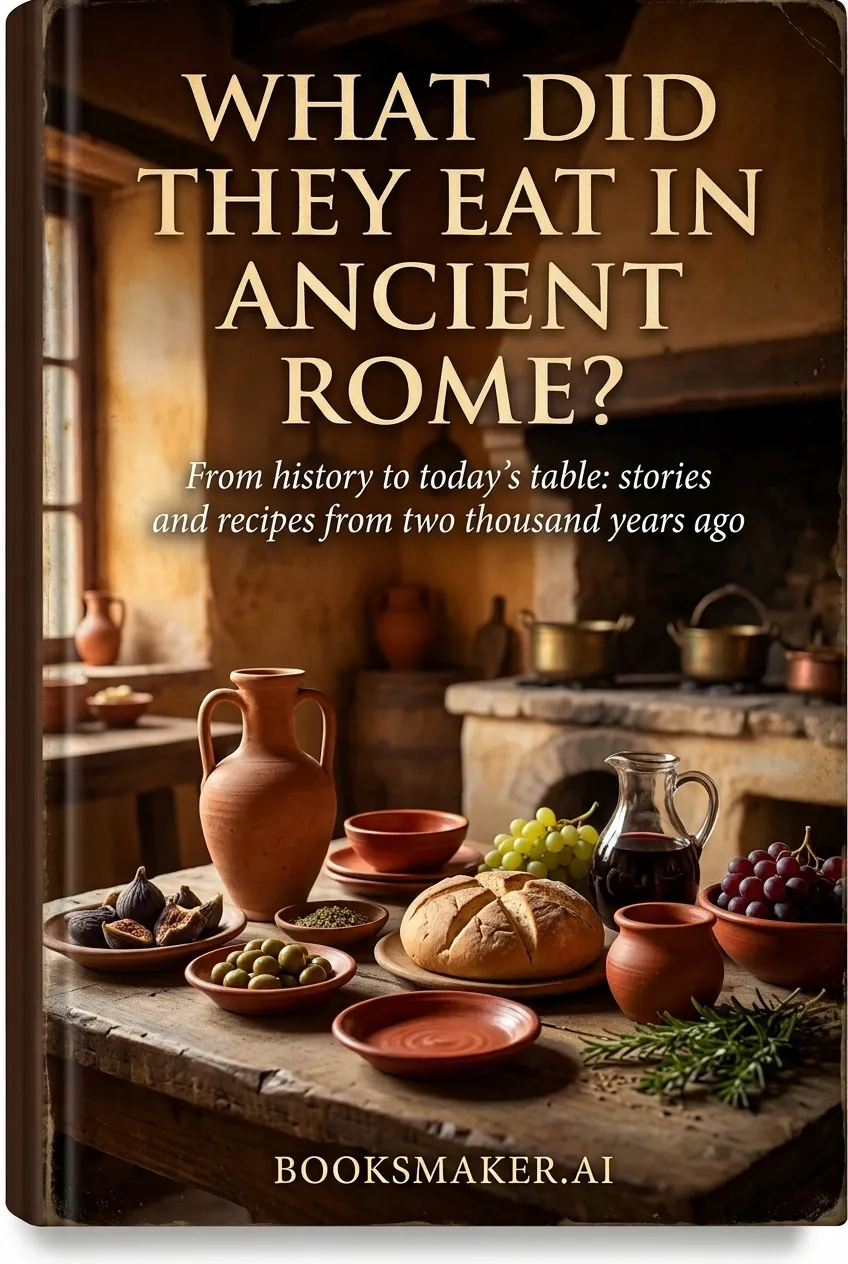
What Did They Eat in Ancient Rome?
by Booksmakerai
English · Complete
Cooking, History · All Ages
Che cosa arrivava davvero sulla tavola di un romano? Tra il profumo del pane appena sfornato, il miele, le spezie e il garum, questo libro ti accompagna in un viaggio nella cucina di du duemila anni fa — per poi portarla, piatto dopo piatto, nella tua casa.
Dai pasti semplici di ogni giorno ai banchetti dei più ricchi, scoprirai che cosa si mangiava, come si cucinava e da dove arrivavano gli ingredienti. Incontrerai la puls di farro, il moretum alle erbe, le polpette, i dolci al miele e le bevande speziate; e conoscerai gli strumenti, le abitudini e le storie che si nascondono dietro ogni ricetta.
Ogni capitolo unisce racconto e cucina: dosi, tempi e passaggi chiari ti guideranno nella preparazione, usando ingredienti facili da trovare e sostituzioni adatte alla cucina di oggi. E quando le fonti antiche non danno quantità precise, il libro distingue con trasparenza i fatti dalle ricostruzioni moderne.
Un ponte tra storia e tavola, pensato per curiosi di ogni età: per leggere, cucinare e condividere una cena romana dall’antipasto al dolce. Perché la cucina dell’antica Roma non è un museo: è una storia che si può ancora assaggiare.
English What really made it onto a Roman’s table? Amid the scent of freshly baked bread, honey, spices, and garum, this book takes you on a journey into the kitchen of two thousand years ago—and then brings it, dish by dish, into your own home.
From simple everyday meals to the banquets of the wealthy, you will discover what people ate, how they cooked, and where the ingredients came from. You’ll encounter farro puls, herb moretum, meatballs, honey sweets, and spiced drinks, while getting to know the tools, customs, and stories hidden behind every recipe.
Each chapter blends storytelling with cooking: clear measurements, times, and steps guide your preparation, using easy-to-find ingredients and swaps suited to today’s kitchen. And whenever ancient sources don’t provide exact quantities, the book transparently distinguishes historical facts from modern reconstructions.
A bridge between history and the table, designed for curious minds of all ages: to read, cook, and share a Roman dinner from appetizer to dessert. Because the cuisine of ancient Rome isn’t a museum—it’s a story you can still taste.
First chapter
The Pantry of Rome
A Note to the Reader
This book is intended to inform and offers a journey through the cuisine of ancient Rome. The reconstructed scenes serve a narrative purpose; where the sources do not allow certainty, interpretations should not be considered established facts. The recipes are modern adaptations inspired by ancient ingredients and preparations, not exact reproductions of the originals.
The recipes have not been practically tested in a kitchen: quantities, times, temperatures, and results have not been validated. The instructions therefore require care and checking during preparation; the appearance of the food alone does not guarantee that it is safely cooked. For cooking, storage, and handling leftovers, follow the current recommendations of health authorities and the manufacturers’ instructions. Do not improvise fish fermentations or other homemade preserves without validated procedures.
Always check ingredients and labels for allergies, intolerances, and personal needs: a substitution does not automatically make a recipe suitable for everyone. Children should cook under adult supervision, especially when using knives, stovetops, and ovens. Alcoholic beverages are for adults who are able to consume them; heating them does not guarantee that the alcohol will be eliminated. For minors and anyone who needs to avoid alcohol, choose genuinely non-alcoholic ingredients and alternatives, including in cooked dishes. Honey should not be given to children under twelve months, even in cooked preparations. Use herbs sold for culinary use: the historical mention of a plant, such as rue, is not an invitation to gather or use it in cooking.
At dawn, as the streets began to fill with footsteps and calls, the market offered a lesson in cooking even before anyone lit a fire. The stalls might hold grains, vegetables, fruit, cheeses, and fish; nearby, shops and vendors offered oil, wine, and preserved foods. No two people shopped in exactly the same way: what was available depended on the neighborhood, the season, and above all each family’s means.
Let us imagine someone arriving with a small basket. We need not give them a name or pretend to know everything they bought: the scene serves to orient us, while the products and traces left by ancient writers and by excavations tell us what might have been in circulation. In a city as large as Rome, food arrived from many regions; some was produced nearby, while other food traveled considerable distances by land and especially by sea.
The pantry, then, was not a storeroom full of exotic ingredients. For most people, simple and filling foods mattered, especially cereals. More expensive or rare goods were not within everyone’s reach, and the lavish table described in texts should not be confused with that of every household. The market, too, reflected a divided society: the same city brought together people who could choose from many foods and people who had to reckon with the price and quantity of what they ate.
Our journey begins here. Before following the focaccia into the home oven, it is worth getting to know the ingredients that shaped Roman cuisine: wheat and spelt, oil, wine, sauces, honey, and herbs.
Of all the products at the market, cereals held a special place. Wheat provided flour for bread, while spelt—an ancient grain, hardy and suited to different preparations—could be cooked whole or ground. The Latin word puls referred to a cereal porridge, often made with water; for a long time it was an essential food, before bread became increasingly common in cities.
Not all flour was the same. The result depended on the grain, the grinding, and how much of the bran was sifted out. Finer flour required more work and could cost more; less-sifted flours retained parts of the grain and made a darker, more substantial bread. The differences were not merely a matter of taste: they also told us who could afford a more carefully processed product.
The wheat that reached Rome did not come from a single region. Routes and supplies changed over time, but the provinces of the empire played an important role in provisioning the capital. Transport by ship made it possible to move large quantities, although it depended on the seasons, the weather, and the organization of supply. The city needed food every day: behind a loaf were fields, harvests, mills, ovens, and many hands.
At home, meanwhile, flour could become bread, focaccia, or a softer preparation. Not every family had an oven; for baking, people could use communal ovens or buy bread ready-made. When we make our focaccia, we will use soft wheat flour and a domestic oven: a practical choice for today, not a claim that we are exactly recreating a Roman loaf.
Beside the sacks of grain, olive oil was a precious and versatile ingredient. It was used for seasoning, cooking, and making sauces; it could also be used outside the kitchen. Quality and price varied, and not every family used oil in equal abundance. In a modern recipe such as our focaccia, oil helps make the dough soft and adds flavor to the surface; the practical purpose is familiar, even if we do not know of a Roman recipe identical to ours.
Wine was widespread, but we should not always imagine it as the wine poured into a glass today. Different varieties were produced in antiquity, and storage could alter their taste. At the table, it was often mixed with water, in keeping with the customs and preferences of the time. For now, it is enough to note that wine and vinegar could be used in food preparation, while in the chapter devoted to beverages we will take a closer look at how people drank.
Garum, on the other hand, was a sauce made by fermenting fish with salt. The name refers to an ancient product, but not to one uniform recipe: ingredients, methods, and quality could vary. It was valued for its intense, salty flavor, which could add depth to many preparations. Ancient sources mention it, and the transport containers and production facilities help us understand how important the trade in this sauce was.
The fish sauce we will make later will be inspired by garum, not an authentic reconstruction of it. Historical garum required fermentation and controlled conditions; it is not prudent to improvise a fish fermentation at home without validated procedures. A commercial fish sauce, used in a small quantity and with attention to allergens, offers a simple way to approach that flavor without pretending it is the same thing.
Honey played an important role because sugar, so common in modern kitchens, was not a regular ingredient on the Roman table. Honey sweetened drinks and preparations, but could also accompany other flavors: sweet foods were not always kept separate from savory ones. Some ancient recipes paired honey with spices, vinegar, or fish sauce—combinations that may seem unusual today and that reflected a taste different from our own.
Cheeses were also part of the pantry. Fresh and aged varieties were made, with characteristics determined by the milk, the processing, and the place. Cheese could be eaten on its own, used in a dough, or pounded together with herbs. In the following chapters, we will encounter preparations in which cheese and cereals become a simple meal or the base of a dessert.
Aromatic herbs offered familiar fragrances and were easy to gather or buy. Mint, coriander, rue, fennel, and other plants appear in recipes and ancient texts, but their presence varied according to availability and preparation. Having a small space for herbs could make a kitchen more varied; one did not need to own a collection of expensive spices to give food character.
When we cook, rosemary will be our choice for the focaccia. It is an herb suited to a home-cooked recipe and easy to find today. We will not, however, present rosemary focaccia as a documented Roman recipe: it is a modern preparation that uses simple ingredients and methods to evoke an ancient pantry. This distinction does not diminish the dish; it helps us know what we are tasting and what we are reconstructing.
Pepper came from very far away and could be expensive. Its presence in recipes and ancient texts shows just how much Roman trade connected distant regions. It was not, however, a spice that every family put into the pot every day: its price and availability made it more accessible to those with greater resources.
Cumin, with its strong aroma, was known and used in cooking. Spices were not used only to mask the taste of preserved foods, as is sometimes repeated: people could choose them for their aroma, according to their customs and the recipe. It is more useful to think in terms of a range of different flavors than a single rule for all of Rome.
Silphium deserves a note of its own. This plant, associated above all with Cyrenaica, was prized in antiquity and became rare; ancient sources recalled its value, but its precise botanical identification and the story of its disappearance are matters of debate. We cannot simply point to a modern spice and declare it identical. Some reconstructions suggest asafoetida as a possible substitute, because it has a pungent aroma, but it is an approximation and should be used sparingly.
The lesson of the pantry is also this: ingredients tell us about routes and trade, but they do not justify filling every dish with exotic flavors. Everyday cooking relied above all on accessible products; rare and expensive spices could enrich certain tables without representing everyone’s experience.
Buying and storing food was part of daily life. Markets and shops offered fresh, dried, or already processed products; people might also receive food from others or grow some themselves, when they had space. A large city concentrated enormous demand and needed a network of transport and distribution. Not everyone shopped in the same way, however: the location of one’s home, one’s occupation, and the money available influenced choices.
Amphorae and other containers were used to transport and store liquids and food. Oil and wine often traveled in earthenware vessels; their shapes and inscriptions help us reconstruct where they came from and how they were traded. At home, cereals and legumes could be stored in dry containers, while fresh products had to be eaten sooner or preserved using different techniques. Salting, drying, and fermentation made it possible to extend the shelf life of some foods, but each method had its own context and did not make everything available in every season.
It is difficult to turn ancient life into a precise price list valid for everyone. Prices changed over time and across regions, and comparing them with a modern wage is complicated: wages, coins, and the cost of living were not equivalent to ours. We can say that cereals and bread were essential and that rare or luxury products required more resources; to give an exact figure, we would need to specify the place, period, and source.
The household pantry was therefore a practical reserve, not a museum of ingredients. It held what was needed for meals and whatever could be bought or produced. This idea is the starting point for our cooking today: choose accessible ingredients, store them carefully, and present reconstructions honestly.
Roman cooking was not the same in every home. A wealthy household might have had a well-equipped space and staff assigned to prepare meals; in many homes, cooking was more difficult. Some urban buildings had little space and few ways to light a fire without smoke or risk. For this reason, there were ovens and sellers of ready-to-eat food to serve those who could not cook everything at home.
Among the utensils, the mortar was particularly useful. Pounding seeds, herbs, and other ingredients made it possible to create mixtures and sauces; the task required strength and patience, and changed the texture as well as the flavor. A sieve separated finer particles from coarser ones. Pots and pans, made from different materials, were chosen according to what had to be cooked and the means of the family.
The domed oven is one of the most immediate images that comes to mind when we think of ancient bread. Bread ovens could reach high temperatures and bake many loaves, but we should not imagine that every home had an identical one. Our kitchen has a modern oven: we will use it following practical instructions and checking the result by visual cues, not pretending that the cooking times are those of a Roman oven.
Every utensil tells us something about the organization of work. Grinding, kneading, lighting the fire, and watching over the cooking took time; the kitchen was made up of repeated actions and experience. When we knead the focaccia, we will revisit some ancient actions—mixing, working, waiting, and baking—with today’s tools and conditions.
Bread was more than an accompaniment: for many people it was an essential part of the meal. Charred loaves have been found at Pompeii, including examples marked into wedges before baking. Those forms, preserved by the catastrophe, bring us for a moment closer to the actions of those who prepared and shared food, even if they do not tell us that every Roman bread looked the same.
Different flours made different breads; shapes, leavening, and ovens also varied from place to place. We do not have a single recipe that describes all Roman bread. For this reason, the focaccia that follows is not a copy of an ancient formula: it is a contemporary home-cooked preparation, made with flour, water, oil, and rosemary, and designed for a domestic oven. The quantities and rising time are indicative and have not been verified through kitchen testing for this edition; observe the dough and use the cues described to guide you.
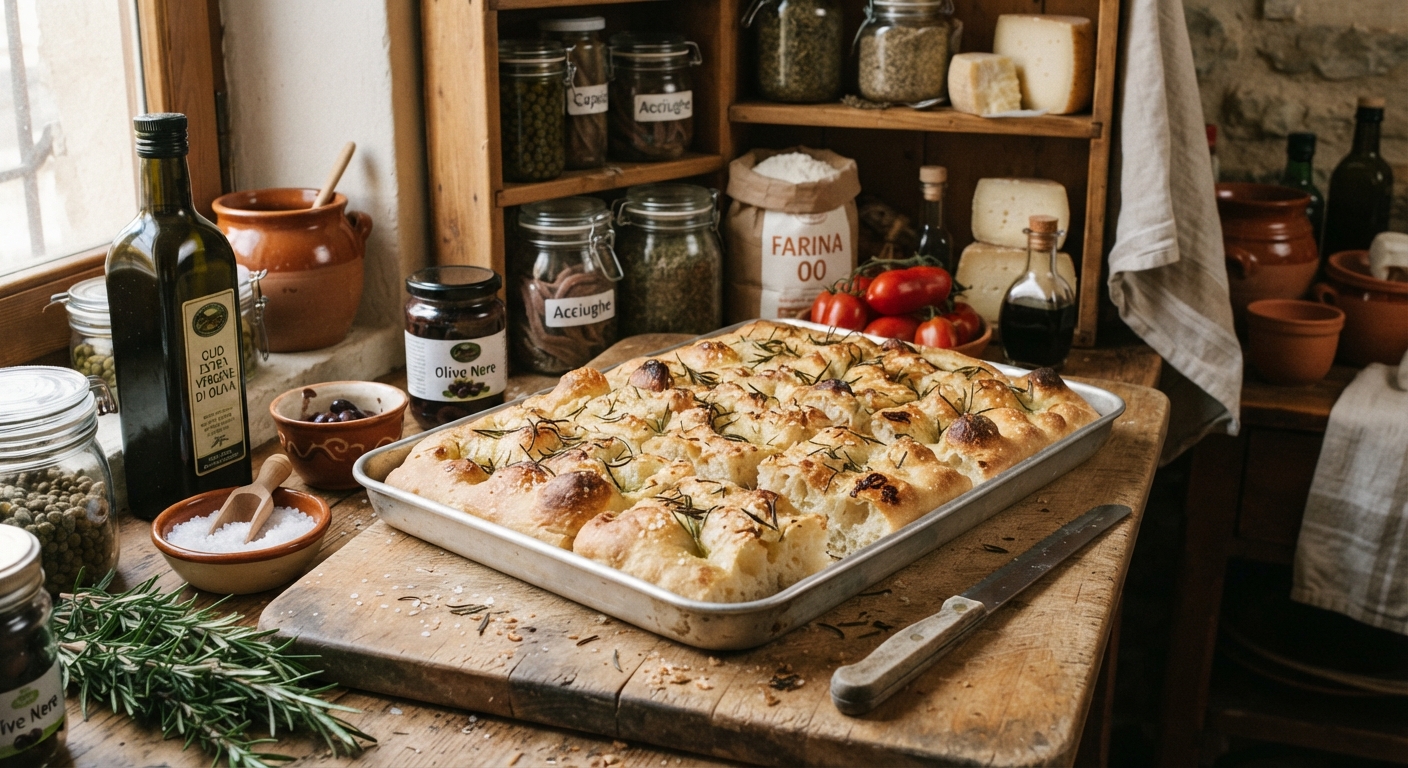
Rosemary Focaccia Inspired by the Roman Pantry
Makes: 4 servings · Preparation: 20 minutes · Rising: about 90 minutes, to be checked · Baking: about 20–25 minutes, to be checked · Difficulty: easy
Ingredients
- 300 g soft wheat flour
- 190 g lukewarm water
- 4 g active dry yeast
- 6 g fine salt
- 25 g extra-virgin olive oil, plus a little for the pan
- 1 teaspoon chopped rosemary leaves
Method
- Dissolve the yeast in the lukewarm water. The water should be just lukewarm, not hot.
- Pour the flour into a bowl and gradually add the water and yeast. Mix until no dry flour remains.
- Add the salt and oil. Knead for about 8 minutes, until the dough becomes smoother and more elastic; if it remains sticky, work with lightly oiled hands instead of adding a lot of flour.
- Cover the bowl and leave the dough to rise in a warm place. The dough is ready when it has visibly puffed up, ideally to nearly twice its volume; the time may vary depending on the room temperature.
- Oil a small baking pan, transfer the dough, and gently stretch it out with your fingers. If it springs back, wait 10 minutes and try again.
- Cover and leave to rest for another 20–30 minutes. Heat the oven to 220 °C.
- Press the surface with your fingertips, scatter over the rosemary, and drizzle with a little oil. Bake for 20–25 minutes, checking as it cooks: the focaccia should be golden and cooked through on the bottom as well.
- Let it cool slightly before cutting. If the center looks moist or raw, continue baking for a few minutes and check again.
Tips, variations, and storage. Contains gluten. You can omit the rosemary or replace it with another aromatic herb. Store leftovers covered and eat them within one day; reheat them thoroughly before serving. This recipe is a modern suggestion to try, not a verified ancient preparation.
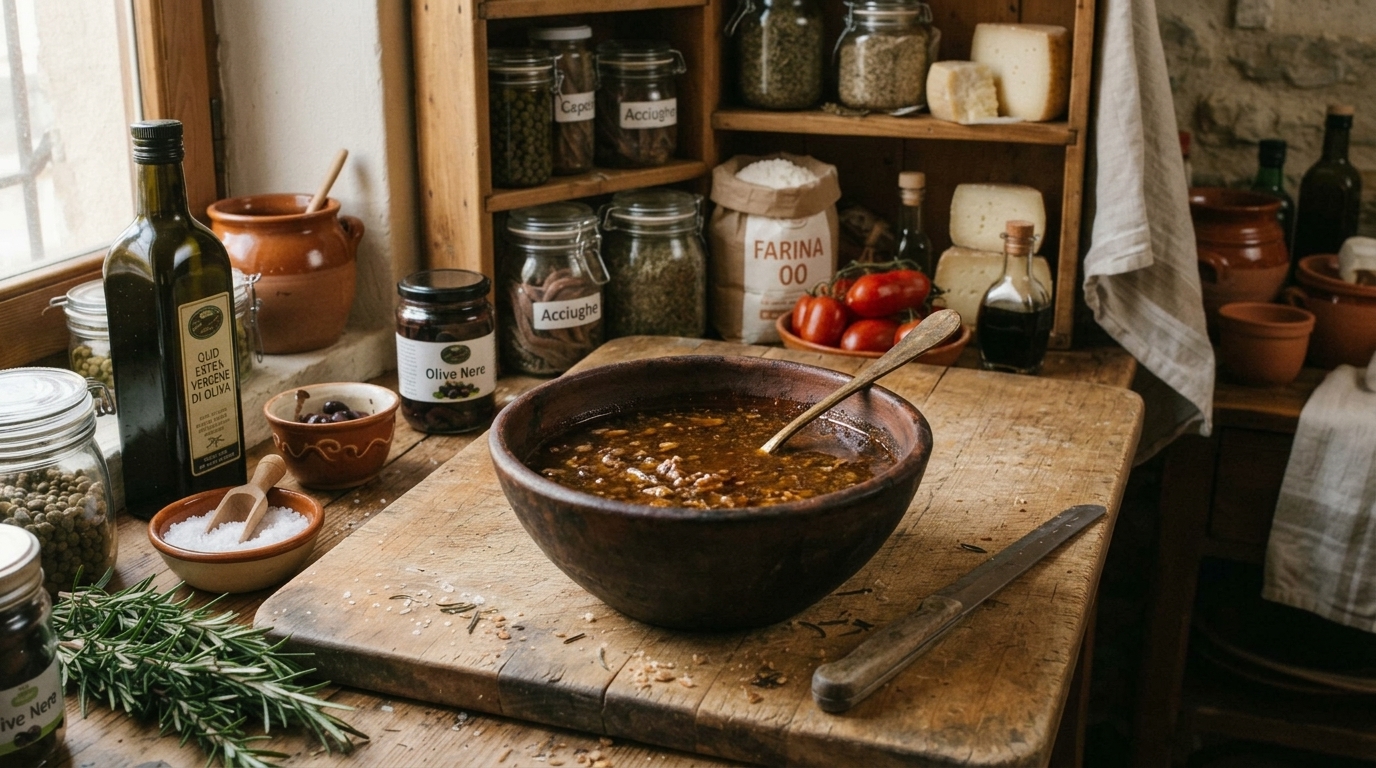
Fish Sauce Inspired by Garum
Ancient garum was a fermented fish-and-salt sauce, not a modern sauce ready in a few minutes. This version is a homemade seasoning inspired by garum’s umami saltiness: it is not fermented and is not a historical reconstruction. Use a safe commercial sauce, check the label, and do not improvise fish fermentations.
Makes: about 4 servings · Preparation: 5 minutes · Cooking: none · Difficulty: easy
Ingredients
- 15 g commercial fish sauce
- 30 g water
- 10 g wine vinegar
- 5 g extra-virgin olive oil
- 1 teaspoon lemon juice, optional
Method
- Pour the fish sauce into a small bowl. Check the label: it may contain fish and other allergens declared by the manufacturer.
- Add the water and vinegar. Mix until the seasoning is uniform.
- Add the oil and, if you like, the lemon juice. Taste a drop with a small piece of bread: if it is too intense, add more water; if it is mild, add a few drops of fish sauce.
- Use it in small quantities to season vegetables or legumes, without adding more salt straight away.
Tips, variations, and storage. The sauce is salty and contains fish; it is not suitable for anyone allergic to fish. For a fish-free version, choose a commercial alternative seasoning, knowing that the taste will be different. Make it just before serving and store any leftovers in the refrigerator, in a clean, closed container, and use them within one day. Do not leave it at room temperature for extended periods.
The Roman pantry was not a fixed list of ingredients: it changed with the seasons, the routes, and the means of those doing the cooking. Spelt and bread fed many people; oil, wine, herbs, honey, and sauces made dishes more varied; spices were a reminder that Rome was connected to distant regions. At home, we can approach those flavors with curiosity, as long as we always distinguish what we know from the modern recipes we invent in order to taste them. In the next chapter, we will enter the everyday dining room, among bread, puls, and legumes.