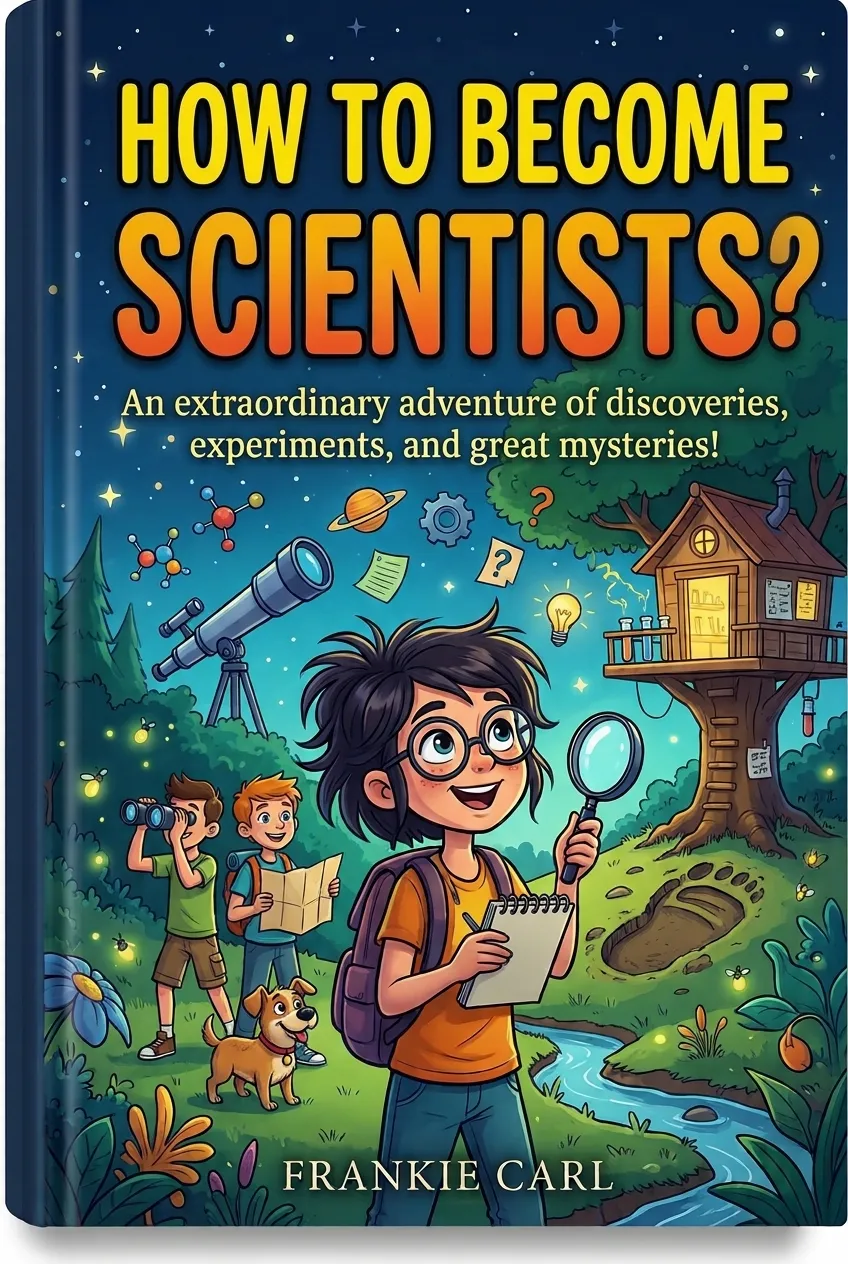
How to Become a Scientist?
by Frankie Carl
English · Complete
Popular science, Science · Kids (6-12 years)
Dopo un temporale, Ada trova nel cortile della scuola una pozzanghera molto più piccola di prima. Dove sarà finita tutta quell’acqua? Insieme all’amico Leo, decide di indagare: osserva gli indizi, annota ciò che cambia e prova a distinguere i fatti dalle supposizioni. Ma le prime idee non sempre bastano, e il mistero si rivela più curioso del previsto.
Tra dialoghi vivaci, piccoli imprevisti e nuove domande, Ada e i suoi amici scoprono come ragionano gli scienziati: formulano ipotesi, cercano prove, si confrontano e, quando serve, cambiano idea. Perché anche un risultato inatteso può insegnare qualcosa.
Come diventare scienziati? è un’avventura divulgativa per lettrici e lettori dai 6 ai 12 anni, senza bisogno di conoscenze scientifiche. Attività facoltative, semplici e sicure invitano a osservare il mondo con occhi nuovi, usando materiali comuni. E mentre la pozzanghera custodisce il suo mistero, si apre anche una finestra sui tanti modi di studiare e lavorare nella scienza.
English After a rainstorm, Ada finds a puddle in the schoolyard that is much smaller than before. Where could all that water have gone? Together with her friend Leo, she decides to investigate: she observes the clues, notes what changes, and tries to tell facts apart from assumptions. But first ideas aren't always enough, and the mystery turns out to be curiouser than expected.
Amid lively dialogue, little hiccups, and new questions, Ada and her friends discover how scientists think: they form hypotheses, look for evidence, talk things over, and change their minds when needed. Because even an unexpected result can teach you something.
How to Become Scientists? is a science adventure for readers aged 6 to 12, requiring no prior scientific knowledge. Optional, simple, and safe activities invite kids to look at the world with fresh eyes using everyday materials. And while the puddle keeps its mystery, it also opens a window onto the many ways to study and work in science.
First chapter
The Question in the Puddle
When Ada arrived at school, the courtyard smelled of rain. The storm the day before had left drops hanging from the gutters and small, shiny puddles between the paving stones. The sun peeked out from behind a cloud, as if it had sneaked a look to check on the mess.
Ada put her backpack down by the door and stopped. In the middle of the courtyard there was a puddle. Or rather: there was a small puddle, with an uneven shape and a thin edge. The day before, when she had left school, there had been a huge one there. Ada remembered jumping around it with such a long leap that she had almost landed inside Leo’s backpack.
“But where did it go?” she said.
Leo, who was trying to close a stuck zipper, looked up. “Who?”
“The puddle. Yesterday it reached almost to the bench. Today it looks like a bowl left behind by a very thirsty giant.”
Leo looked across the courtyard. “Maybe the giant came back last night.”
“And took only the water?”
“He was thirsty. We can’t judge him.”
Ada laughed, but she kept staring at the shiny patch. The puddle didn’t have legs. It didn’t have a door it could walk out through. And yet it had become much smaller.
For a moment, she thought the sun had dried it up. It was a ready-made answer, simple and even plausible. But a question got in her way: if it had been the sun, what exactly did that mean? And why hadn’t the puddle disappeared all at once?
The courtyard was filling up with voices and footsteps. Ada pointed to the water for Leo. “Come on. Let’s take a better look first, then see if we can figure it out.”
Leo finally freed the zipper. “All right. But if the giant comes back, I’ll ask questions from a respectful distance.”
The two of them approached without stepping on the edge. They didn’t have an explanation yet. All they had was a puddle smaller than the one they remembered and a question that wouldn’t leave them alone.
Ada crouched down, keeping her shoes away from the water. Up close, the puddle was even less impressive: a patch about as wide as her science notebook, maybe a little more. But the ground around it was dark and shiny. A little farther away, the paving stones looked almost dry.
“Was it really big yesterday?” Leo asked.
“Yes. I didn’t measure it, but I remember it reached almost to the bench.”
“Then we have a problem.”
“What problem?”
“If you didn’t measure it, how do we know it was bigger?” Leo looked very serious, but one corner of his mouth was tugging upward.
Ada narrowed her eyes. “Because yesterday I had to jump so I wouldn’t get wet. Today I can step over it without even tying my shoes.”
“Don’t actually try it. Mrs. Riva always says running on a wet floor is an idea for inexperienced penguins.”
Ada stood up. He was right: she didn’t have an exact measurement from the day before. But she remembered where the water had reached and the jump she had made. It wasn’t perfect evidence, she thought. Still, it was a useful memory to check against other observations.
Just then, a girl from their class ran past and jumped over the puddle. She landed on the other side without getting wet.
“There’s a measurement!” Leo said. “One and a half girls wide.”
“That’s not a very handy unit of measurement.”
“Depends on the girl.”
The bell hadn’t rung yet, but more students were arriving in the courtyard. Ada looked again at the little mirror of water. It occurred to her that a question could start like this: something changes, and you want to know why. You didn’t need a laboratory, a lab coat, or a complicated machine. You just had to notice the change and not let it slip out of your mind.
“The question is: where did the water go?” she said.
Leo nodded. “And the answer could be: into the giant.”
“We’ll put that under ideas to check.”
“With a giant as a research assistant?”
“Only if he promises not to drink the notebook.”
“Before we go in, let’s check something,” Ada suggested. “If the giant came by, maybe he left footprints.”
Leo looked around with exaggerated care. “Enormous footprints, of course. And cookie crumbs. Giants are always hungry.”
They walked along the edge of the courtyard without going far from the door. There were leaves stuck to the ground by the rain, a few little stones, and a strip of mud near the gutter. No footprints as big as a bathtub. No crumbs. No giant hiding behind the trash can, although Leo checked anyway.
“We haven’t found any evidence of the giant,” Ada said.
“Not yet,” Leo clarified. “He might be very good at cleaning up.”
“Or your explanation is just a joke.”
“A very scientific joke.”
Ada shook her head. “A joke can give us an idea. But it isn’t enough to prove the idea is true.”
Leo put a hand on his chest. “Are you saying I’m not a giant?”
“We can check that with a measuring tape.”
“And what if the measuring tape is faulty?”
They laughed softly. Then Ada took out her little notebook from her pocket, the one she used to draw imaginary animals and jot down things she wanted to remember. On a blank page, she drew a crooked circle. “This is today’s puddle.”
“It looks like a potato.”
“It’s a puddle seen from above. Potatoes don’t usually reflect clouds.”
Leo bent over to look at the drawing. “And here you write: ‘No giant found, but the check isn’t conclusive.’”
Ada wrote exactly that, then added: “Joke idea: someone drank the water. To check?” She stopped and smiled. “No, we’re not really checking that. We don’t need to chase giants. We need to figure out which possibilities make sense and how to tell them apart.”
The page already had two different things on it: a drawing of what they could see and an imagined explanation. Ada drew a line between them. On one side was the small puddle, right in front of their eyes. On the other was the idea of the thirsty giant.
“That way, we won’t end up confusing what we know with what we make up,” she said.
Leo looked at the line. “The giant is sad, but science is tidier.”
“But we’ve discovered one thing,” Ada said. “If we want to understand the puddle, we have to look for something we can observe.”
Leo pointed to the drawing. “We can observe that it’s small. We can also observe that there’s no giant. But we can’t observe the giant drinking, because we didn’t see it happen.”
“Exactly. And if someone asked us how we know it was the sun, it wouldn’t be enough to say ‘because’ or ‘because it seems right.’ We’d have to find a way to check.”
“Like waiting for the giant to come back?”
“Better not. He might be allergic to notebooks.”
Leo bowed to the puddle, as if apologizing for accusing it without evidence. Then he stood beside Ada. The courtyard suddenly seemed like a different place: not just somewhere to run around before the bell, but a place full of details to notice.
The strip of mud, for example, started near the gutter. A leaf had stuck to a paving stone. And the puddle, just as they were talking, quivered a little in a gust of wind.
“Can anything become a clue?” Leo asked.
“It can be a clue, but we have to figure out what it’s a clue to.”
“Like when you find a crumb and immediately think of a cookie?”
“Or a hungry pigeon. One crumb by itself doesn’t tell us who left it.”
Leo looked at the page. “So one thing we see can have more than one explanation.”
Ada nodded. The drawing didn’t solve the mystery, but it kept them from forgetting where they had started. The puddle was small. There was mud and there were dry patches around it. The giant, on the other hand, was still just a joke.
“Shall we go in?” Leo said.
Ada closed the notebook, but didn’t put it back in her backpack. “Yes. Before the bell, I want to remember what it looked like yesterday. Maybe that will give us a clue.”
In class, Ada kept thinking about the puddle. During math, she drew a bench, three paving stones, and a big blue patch in the margin of her notebook. Then she erased the patch and drew it smaller.
“If you draw that again, the puddle will turn into a postage stamp,” Leo whispered from the desk next to hers.
“I’m trying to remember.”
“Then draw the acrobatic leap too.”
Ada added an arrow and a figure that looked like an insect with arms. “Is that supposed to be me?” Leo asked.
“It’s the jump.”
“I feel represented.”
The teacher was explaining fractions. Ada started listening again, but every now and then her eyes drifted toward her notebook. The puddle from the day before hadn’t had a perfect shape. It followed the cracks between the paving stones and curved around a crack. It had seemed big because she’d had to change her route to avoid getting wet.
At recess, the two friends sat on the bench overlooking the courtyard. Ada tried to remember what time she had left. The storm had been moving away. The last drops were still tapping on the roof, and water was running down from the gutters. The water had gathered in the lowest part of the courtyard, right by the bench.
“I think it reached here yesterday,” she said, pointing to a paving stone. “But I’m not sure exactly where the edge was.”
Leo looked at the spot. “I remember we raced to see who could jump farther.”
“And who won?”
“The puddle. It got both of my shoes wet.”
Ada wrote in her notebook: “Yesterday, after the storm: water spread farther, near the bench. A memory, not an exact measurement.” Then she drew a little picture of the courtyard from above. She didn’t mark distances with numbers. Instead, she drew an approximate outline and added a question: “How big was it really?”
“Why do you write that it’s a memory?” Leo asked.
“Because we didn’t take a photo or measure the edge. We can say that it seemed bigger to us. But that’s different from knowing exactly how big it was.”
Leo thought for a moment. “So memory is useful, but it can be wrong.”
“Yes. It gives us a place to start. Then we can look for more precise observations.”
Ada turned the page toward him. The blue patch looked enormous next to today’s little puddle. But the drawing wasn’t proof: it was a way to keep what they remembered together, without turning it into a measurement they had never made.
“If we were scientists with a time machine, we could go back to yesterday and measure it,” Leo said.
“Or we could start measuring it today, if we want to know how it changes from now on.”
“So we can’t get back the information we’re missing?”
“Not yesterday’s. But we can be honest about what we don’t know.”
Leo grimaced. “Not knowing is a little annoying.”
“Sometimes. But making up a measurement would be worse.”
Under the drawing, Ada wrote: “We don’t know exactly how much water there was yesterday.” It seemed like a small sentence to her, yet an important one. If she had written down a number at random, the notebook would have seemed more certain, but it would have told something untrue.
Leo took the pencil and added an enormous question mark above the bench. “Now you can see we’re missing a piece.”
“Now it looks like the bench is thinking.”
“Maybe it’s wondering where the water went, too.”
Ada smiled. She realized that remembering together was different from remembering by herself. Leo noticed things she hadn’t thought of: the jump, his wet shoes, the rain still on the roof. She had noticed the point where the water reached and the crack between the paving stones. Neither of them had the whole picture.
When the bell rang, Ada put away her notebook. Before going in, she turned around one last time to look at the courtyard. The puddle was still there, but from that moment on, it seemed less like a patch and more like a question with many pieces: what it had been like yesterday, what it was like today, and what had happened in between.
“Shall we look at it again tomorrow?” Leo asked.
“Yes. And maybe this time we’ll pay attention to what we see, not just what we remember.”
After classes, the courtyard was almost empty. Ada and Leo asked the teacher if they could stay by the door for a moment to look at the puddle. She said yes, as long as they stayed on the dry path and didn’t go near the gutter.
The sun was higher than it had been in the morning. The clouds had moved away, and in many places the ground no longer glistened. Ada stopped in the doorway and pointed to the dry paving stones.
“Was it the sun?” Leo asked.
“It’s one possibility. But first let’s look at everything there is.”
They didn’t go into the wet part. From where they were, they could see a large dry area, a dark patch near the puddle, and a few drops still clinging to the gutter. The puddle remained inside the crack between two rows of paving stones. A few steps away, the ground near a flower bed looked dark.
Ada opened her notebook again. She divided the page into two columns. At the top, she wrote “I See” on one side and “I Think” on the other.
“I see the sun,” Leo said.
“I see dry patches and dark patches.”
“I see that the puddle is still here.”
“And that it’s smaller than the one we remember.”
Ada wrote the first three sentences under “I See.” She put the last one next to the drawing of the day before, clarifying that it was a comparison with their memory. Then Leo said, “I think the sun dried up the courtyard.”
That sentence went in the other column. Ada added: “Possible, needs checking.”
“Why don’t you put it in the first column?” Leo asked.
“Because we can see the sun. But that it was the sun that made the water disappear is an explanation. Maybe it’s a good idea, but we haven’t proved it yet.”
Leo peered at the notebook. “So if I write that the sun is having a party with the drops, it goes in the ideas column?”
“Yes. And if you add that the drops invited the giant, the column will get crowded.”
Leo pretended to write it down. “Party for the drops. The giant brings cookies.”
Ada laughed, then looked back at the ground. The edge of the puddle was uneven. In some places the water reached the next paving stone; in others, it seemed to seep along a crack. She couldn’t tell whether it had moved or had always been like that. She hadn’t followed the edge throughout the day.
“There are clues, but they don’t tell us just one thing yet,” she said.
Leo nodded. “Like the giant’s footprints that aren’t there.”
“Those aren’t there at all. These, though, we can describe.”
Ada wrote: “Paving stones mostly dry; dark ground near the puddle; water still present in the crack.” She realized that putting the words on the page helped her look more closely. When she tried to explain everything right away, she risked forgetting the simplest details.
The teacher called them from the door. “It’s time to go. Watch out for the wet ground.”
“Let’s go,” Ada said. “Tomorrow we’ll see if anything has changed.”
They left the courtyard, leaving the puddle where it was. No overturned bucket, no broken pipe, no giant. But the sun, the dark ground, and the cracks between the paving stones had become questions to follow up on.
That evening, Ada told her mother about the puddle while she tidied her notebooks on the table.
“It was big yesterday and small today,” she said. “Where do you think the water went?”
Her mother set a cup on the counter. “I don’t know. What did you observe?”
Ada had expected a ready-made answer, maybe that it was the sun. Her mother’s question surprised her. She opened her notebook and read her notes: the paving stones were mostly dry, the ground was dark near the puddle, and the water remained inside a crack.
“And then the sun came out,” she added.
“You saw that. Whether its presence caused the change is another matter. How could you find out?”
Ada didn’t have an answer. “I could go back tomorrow. If the puddle is even smaller, does that mean the sun made it disappear?”
“Not necessarily. Other things might have changed. But observing more than once would help you understand what happens over time.”
Her mother didn’t add anything else. She didn’t take the notebook to write in it for Ada and didn’t suggest a solution. She just handed her a pencil, because hers had gone blunt.
Ada drew a line with two dots: “yesterday” and “today.” Under the first, she wrote “rain stopped not long ago; big puddle, according to memory.” Under the second: “sun; small puddle; courtyard partly dry.” She drew an arrow between the two dots.
“Something happened here,” she said.
“Yes. But we don’t know exactly when, or how.”
Ada circled the arrow. The puddle hadn’t shrunk in front of her eyes. It had changed while they weren’t watching: between leaving school and the next morning, or maybe in an even shorter stretch of time. Her memory of the day before was a little fuzzy. To find out more about what was happening, they would have to observe from that moment onward.
“I’ll tell you the rest, too,” Ada said to her mother. The memory took her back to that morning, before recess, when she had returned to the door with the teacher’s permission.
The puddle was still there. Ada stopped in the doorway and looked toward the bench, as if the courtyard were a page she had to read before turning it.
The puddle seemed similar to the one she had seen when she arrived, but she wasn’t sure. The lines between the paving stones still showed her that it was small. The edge, though, was so uneven that it looked different every time.
“Has it changed?” Leo asked, arriving behind her.
“I don’t know yet. We’d have to compare carefully.”
“Can we use the bench as a ruler?”
“We can remember where it is compared with the bench, but we can’t call it a ruler.”
“Too bad. The bench would have been proud.”
Ada opened her notebook to a new page. She wrote the date and time, then added: “Puddle still present.” She paused, crossed out the word she had misspelled, and wrote it again: “Puddle still present.”
“This time we’ll write down when we look,” she said. “Then we won’t have to guess everything afterward.”
Leo searched his pencil case for a pencil. “And what if it’s gone in an hour?”
“Then we’ll know it changed sometime between now and an hour from now. We still won’t know why, but we’ll have one more piece of information.”
Leo thought that sounded like a rather slow answer. “Doesn’t science have a button that jumps straight to the solution?”
“If it does, it must be hidden behind the eraser.”
“My eraser has already disappeared. Maybe the giant drank it.”
Ada laughed. Then they both looked back at the puddle. The change was no longer just something that had happened yesterday. From that moment on, they could follow it, one visit at a time.
“The sun might have drunk the water,” Leo said, staring up at the sky.
Ada looked at the notebook. “That’s a funny way to put it. But the sun doesn’t have a mouth.”
“Maybe it has an invisible mouth.”
“Then we’d have to explain what we mean. The water disappeared from the puddle, but that doesn’t mean it disappeared from the world.”
Leo wrinkled his nose. “How can it not disappear if we can’t see it?”
“It might have moved somewhere else. Or it might have changed into something we can’t see easily.”
Ada remembered a pot on the stove, when hot water made a thin cloud. Her mother had explained that some of the water turned into vapor: a gas that mixed with the air, invisible to their eyes. But Ada didn’t know if that was what had happened to the puddle, or how much.
“Maybe some of it turned into vapor,” she said. “And maybe some of it went into the ground.”
“And maybe the giant drank it.”
“We’ll leave that out of the serious explanations.”
Leo gave a military salute. “Goodbye, giant.”
They wrote two possibilities in the ideas column: “water passed into the air as vapor” and “water went into the ground.” Ada put a question mark next to both.
“How do we know which one is right?” Leo asked.
“We don’t know yet. Both could be true, or only one, or neither in the way we’re imagining them.”
“So we don’t just choose the one we like best?”
“We can have a favorite, but we have to look for evidence.”
Leo stared at the sun. “I like the vapor one. It sounds like a magic trick.”
“Science can seem like magic when we don’t know how it works. Then we try to understand.”
“And what if the answer is boring?”
“Even a simple answer can hide lots of questions.”
Ada wrote in the margin: “What could we observe to tell the possibilities apart?” She didn’t have a plan yet, but the mystery had changed shape. They weren’t just asking where the water had gone anymore; now they were wondering what explanations were possible and how they could be tested.
“Can you see vapor?” Leo asked.
“Sometimes we see a little cloud near hot water, but water vapor itself in the air is invisible. That little cloud is made mostly of tiny droplets that form when the vapor cools.”
Leo looked carefully across the courtyard. “So we don’t see a little cloud above the puddle.”
“We don’t see one. But that alone isn’t enough to say there wasn’t any vapor.”
“It’s complicated.”
“A little. That’s why we don’t write ‘the sun drank the water’ as if it were proven. We write that we’re trying to understand.”
Ada drew an arrow from the puddle toward the air and another toward the ground. They weren’t arrows showing what had happened; they were possibilities. To remind themselves, she made them dashed.
“This is the air, this is the ground,” she explained. “It’s not an exact map. It’s just to help us remember the ideas.”
Leo added a little cloud wearing sunglasses next to the first arrow. “The vapor went on vacation.”
“We don’t know if it really went away.”
“It’s a hypothetical vacation.”
Ada wrote “hypothesis” above the list. The word meant an idea that might explain something, but still had to be checked. It wasn’t a certain answer, and it wasn’t a fantasy to dismiss right away. It was a suggestion to test.
“So a hypothesis is sort of like a lead?” Leo asked.
“Yes, a lead that tells us where to look next.”
“And what if the lead is wrong?”
“Then we learn that we have to look for another one.”
The teacher, who was coming out of the door, heard them. “Just remember not to touch the water and not to go into the flower beds. You can observe from the path.”
“Yes, Miss,” Ada replied.
The rule didn’t spoil their investigation. In fact, it gave her an idea: they didn’t need to put their hands in the puddle or do dangerous experiments. They could start by observing, drawing, and taking notes. If later they wanted to try something, they would ask an adult to help them choose a safe way to do it.
Leo closed the notebook carefully. “We have two leads, one puddle, and no giant.”
“That’s enough for today.”
“Tomorrow, shall we look for clues for the leads?”
“Tomorrow, we’ll take a better look.”
Ada knew that taking a better look didn’t mean staring at the water until it confessed. It meant noticing details, asking questions, and not turning an idea into a certainty just because it sounded good. The two dashed arrows stayed on the page, waiting for evidence.
Ada looked again at the area near the flower bed. The ground was dark in one spot and lighter in another. She didn’t know if it had always been that way: she didn’t have a photo of the courtyard from before the rain.
“If the water went into the ground, why didn’t it go in everywhere?” Leo asked.
Ada pointed to the paving stones. “Maybe the ground and the pavement aren’t the same. But that’s just an idea.”
“Can the ground absorb water?”
“I think so. But we don’t know how much of it went in here.”
Leo suggested that the ground had drunk like the giant, but Ada reminded him that “absorb” didn’t mean it had really drunk the water. The water could seep into the spaces between the grains of soil, even if they couldn’t see it. It might also have collected somewhere beneath the surface. To find out, they would need more observations and perhaps an adult’s help.
They wrote down the question without answering it: “Did the dark soil absorb water?” Beside it, Ada added: “Don’t touch; observe from the path.” They didn’t want to dig or make a mess in the courtyard while chasing an explanation. For now, it was enough to notice that the areas weren’t all the same.
Ada turned the page and wrote in big letters: “What do we know?” Below it she put three points: the puddle was still there; the courtyard was partly dry; near the water there was a patch of dark soil. Then, in a separate box, she added: “What are we imagining?” There she listed the vapor and the water that had gone into the ground.
Leo read the page. “That way, we won’t forget which thing we saw and which thing we thought.”
“Exactly. And when we have new observations, we can add them.”
“Can we draw the giant too?”
“On the back. But he has to stay in the joke box.”
Leo drew a very tall creature with an umbrella and an empty glass. Ada wrote underneath: “Not observed.” The notebook now contained memories, details, and possibilities, each in its proper place. It didn’t give them the solution, but it stopped ideas from dressing up as facts.
Ada read every line again. “We won’t write ‘the sun dried up the puddle.’ We’ll write ‘the sun might have contributed.’”
“That’s a longer sentence,” Leo said.
“But more precise.”
He sighed as if precision were an exercise in gymnastics, then copied the sentence onto his own page. “Might have contributed. Sounds like a sentence wearing glasses.”
“Then draw it some, too.”
Ada’s story reached the bell, which had rung just as Leo was adding a pair of glasses to the sentence. The children headed toward their classrooms. Ada closed the notebook and put it in her backpack, leaving the bookmark on the puddle page.
They hadn’t found the answer. They had found a better question, a few observations, and two explanations to check. For the moment, that was all they could say without making up the rest.
Before going back inside, Ada looked once more at the dark strip near the edge. Leo bent down a little, staying on the dry path.
“That part looks different,” he said.
“Yes. But we don’t know if it’s dark because it’s wet or if it was already dark.”
“Can we check tomorrow?”
“We can look to see if it changes. Without touching it.”
Leo added a little drawing of the strip in the notebook. The question was no longer just where the water had gone: the ground might have something to tell them, too, if they learned to observe patiently.
“Shall we come back tomorrow?” Leo asked, as the teacher called them from the door.
“Yes. We’ll look at the puddle and the ground, and write down what has changed.”
“And what if the giant comes back in the meantime?”
“We’ll write that down, too. But first we’ll look for his footprints.”
Leo slung his backpack over his shoulder. “Then the mystery is still open.”
Ada looked one last time at the little patch of water. “For now, yes.”
They didn’t know where the water had gone, or which of their ideas was right. They had a question, a few clues, and a notebook full of observations and possibilities kept separate. Ada closed the notebook on the table at home: the next day, they would look again. The investigation had just begun.