BookTok Strategy 2026: From Zero to Readers
A BookTok strategy for 2026: Italian market data, five repeatable formats, the H.O.O.K. framework with scores and a threshold, TikTok Shop, and the metrics that matter.
Stay updated with our newsletter
Receive exclusive tips, resources, and updates to turn your ideas into bestselling books.
A BookTok strategy that holds up in 2026 rests on three things: five repeatable formats, a hook that survives the first two seconds, and thirty videos published before you draw conclusions. In Italy the community generated 3.3 million copies and 41.4 million euros in sales in 2025, according to NielsenIQ BookData figures cited by TikTok. The audience is there, the volume is there, and it is not concentrated only in accounts with hundreds of thousands of followers.
Most BookTok advice splits into two versions: post consistently and hope, or buy a formula that promises virality. Neither holds. The platform does not reward consistency by itself; it rewards a format the audience recognizes and an opening that does not make the thumb move. The boring part nobody mentions is that you need enough videos for the algorithm to learn who should see them.
This guide starts from the Italian numbers, lists the formats that perform, and shows how to score them with the H.O.O.K. framework, a 20-point grid with a publishing threshold. You also get what changes with TikTok Shop, how to plan a month of posting, and which metrics to read instead of views. By the end you have a plan to run this week, not a theory to postpone.
Table of contents
- Key definitions
- The numbers behind BookTok in Italy
- Which books BookTok can actually move
- The five formats that work
- The H.O.O.K. framework for a BookTok strategy
- Cadence: thirty videos before you judge
- Sounds, the Bestseller List, and TikTok Shop in Italy
- Working with creators without burning budget
- Five mistakes that stall a BookTok strategy
- What to measure instead of views
- How to produce thirty pitches with AI
- Frequently asked questions
Key definitions
BookTok borrows its vocabulary from publishing and fandom culture. Fixing the terms first is worth the minute, because most confused advice comes from the same words carrying different meanings.
BookTok: the community of readers, booksellers, and creators on TikTok who post reviews, recommendations, and commentary about books. It is not a format or a separate algorithm, it is a body of content recognized by the hashtag and a shared language.
Trope: the recurring story pattern a reader searches for by name, such as enemies to lovers, slow burn, or forced proximity. On BookTok it works as a search label, not as a quality judgment.
Hook: the first sentence or first image of a video, the one that decides whether the viewer stays. It is not the book title and it is not an introduction of the author.
Romantasy: the genre that combines romance and fantasy, with a central love story inside a fantasy world. It has driven much of the BookTok sales growth of recent years.
Aesthetic edit: a montage of images that match the book's atmosphere, set to a sound, with a single line of text. It shows the world of the story, not the plot.
Backlist: the catalog an author or publisher released earlier. On BookTok a video can put a title from years ago back on a bestseller list, and it is one of the few channels where that still happens regularly.
The numbers behind BookTok in Italy
The most useful Italian figure for deciding whether a BookTok strategy is worth the time is the sales attributed to the community. In 2025, copies linked to #BookTok reached 3.3 million, for 41.4 million euros in revenue, according to the NielsenIQ BookData and Media Control analysis published by TikTok when the #BookTok Bestseller List arrived in Italy in April 2026. Across Europe the same analysis counts more than 50 million books sold and 800 million euros.
The global scale is different again. The hashtag passed 370 billion views and 52 million creations in 2025, according to figures reported by Forbes, while TikTok reports more than 75 million posts using the hashtag and more than a third of 16 to 39 year olds discovering new books on the platform (TikTok Newsroom).
Two Italian details change the practice compared with two years ago. The first is the Bestseller List: the monthly #BookTok ranking now exists in Italy too, with official stickers bookstores can apply to the titles on it. The second is the composition of the March 2026 list, where 13 of 20 titles were by Italian authors, with romance and series as the dominant category. In plain terms, the Italian audience does not only reward phenomena imported from abroad, and an author publishing in Italian has real room.
Keep a brake on these numbers. BookTok-attributed sales are an estimate built on titles with a measurable sales increase connected to platform trends, not an exact share of the market. They are useful for judging the order of magnitude and justifying a few hours a week, not for building a financial plan.
Which books BookTok can actually move
A BookTok strategy cannot treat the platform as a general book discovery engine. It is an emotional recommendation engine, and it works where a reader can decide from a feeling rather than from a summary. The table compares genres on four criteria: why the format works, the video that performs best, the main risk, and the fit between promise and content.
| Genre | Why it works | Best format | Main risk |
|---|---|---|---|
| Romance and romantasy | Tropes are a shared vocabulary, readers already search the label | Trope reveal | Promising tropes the book does not deliver |
| Dark fantasy and horror | Atmosphere is visual, one unsettling line does the selling | Aesthetic edit | Generic imagery disconnected from the text |
| Thriller and mystery | One withheld question carries the whole video | POV hook | Spoiling the culprit to explain better |
| Literary and book club fiction | Works when the emotional damage has a recognizable name | First line read aloud | Pitching the writing instead of the story |
| Memoir and narrative nonfiction | Needs a specific, surprising personal stake | Process vlog | Summarizing an entire life in twenty seconds |
| Technical and business nonfiction | Decisions come from search, credibility, and reviews | None, use search and email | Explaining instead of making anyone feel |
If your book sits in the strongest band, the first job of a BookTok strategy is not filming: it is naming your tropes accurately, using the words readers actually type into search. If you write technical nonfiction, time spent on BookTok returns less than an editorial plan built on search and email. This is not genre snobbery, it is a format constraint: fifteen seconds hold one promise, and the promise has to fit in one line.
The five formats that work
You do not need a BookTok strategy with twelve pillars. You need five repeatable shapes you can film in ten minutes each, so that posting daily stays a habit instead of a production. The formats below keep working because they match how readers already talk about books.
1. The trope reveal
Text on screen, three to five tropes listed one per beat, no plot summary. It is the highest-converting format in a BookTok strategy for genre fiction because it matches how readers search: the label first, the title after. The discipline is honesty. If you list a slow burn and the couple kisses on page four, the comments will say so, and the algorithm reads that dissatisfaction.
One advantage for non-English markets: tropes circulate under their English names inside local communities too, so you can use them untranslated and stay recognizable. What matters is that the video does not become a flat list. Put the most specific trope in the first beat, the one that separates your book from ten others with the same label.
2. The POV hook
A second-person line that puts the viewer inside a scene, not a description of the scene. The difference between "POV: your rival proposes to save your kingdom" and "my book is about an arranged marriage" is the difference between a hook and an announcement. The first asks the viewer to imagine being the character, the second asks them to care about a synopsis.
It works best with one concrete detail and an implied cost. "POV: you sign the contract that saves your family and find out the clause binds you to the person you betrayed" contains a stake and a consequence. A POV without a stake is a setting, and settings do not hold attention.
3. The aesthetic edit
Four to six images that match the book's world, cut to a sound, with one line of text on the last frame. It is the cheapest video to produce and the easiest to make forgettable. It only works when the images are specific to your book: the blanket on the sofa, the messy room, the object that appears in a key scene. A folder of generic mood images is not enough, and viewers can tell.
If you have no footage of your own, you can build atmosphere clips with an image or video generator, keeping one recurring detail fixed across scenes. A consistent detail, always the same window or the same notebook, gives the montage continuity and pulls it away from slideshow territory.
4. The process vlog
Show the making, not the product: the outline on the wall, the chapter that got cut, the proof copy arriving. These videos build the small loyal audience that buys book two, which is the actual point of an author account. They rarely go viral, and that is fine. They are not supposed to.
A vlog works when it contains a problem and a decision. "I cut chapter 12" is a headline. "I cut chapter 12 because the character had become too likeable" is a story. Vlog audiences do not buy the plot, they buy the way you work.
5. The first line read aloud
Read your opening on camera, no introduction. It is also a brutal test: if your own opening does not hold you for eight seconds while you read it, it will not hold a browsing reader. Voiceover works better than talking to camera for authors who do not want to appear, as long as the on-screen text is legible and does not cover the page.
If the opening wobbles, the problem is in the manuscript and no format saves it. Rewrite the first lines before refilming. For a method on openings, the guide on how to write a story works on the first scene directly.
The H.O.O.K. framework for a BookTok strategy
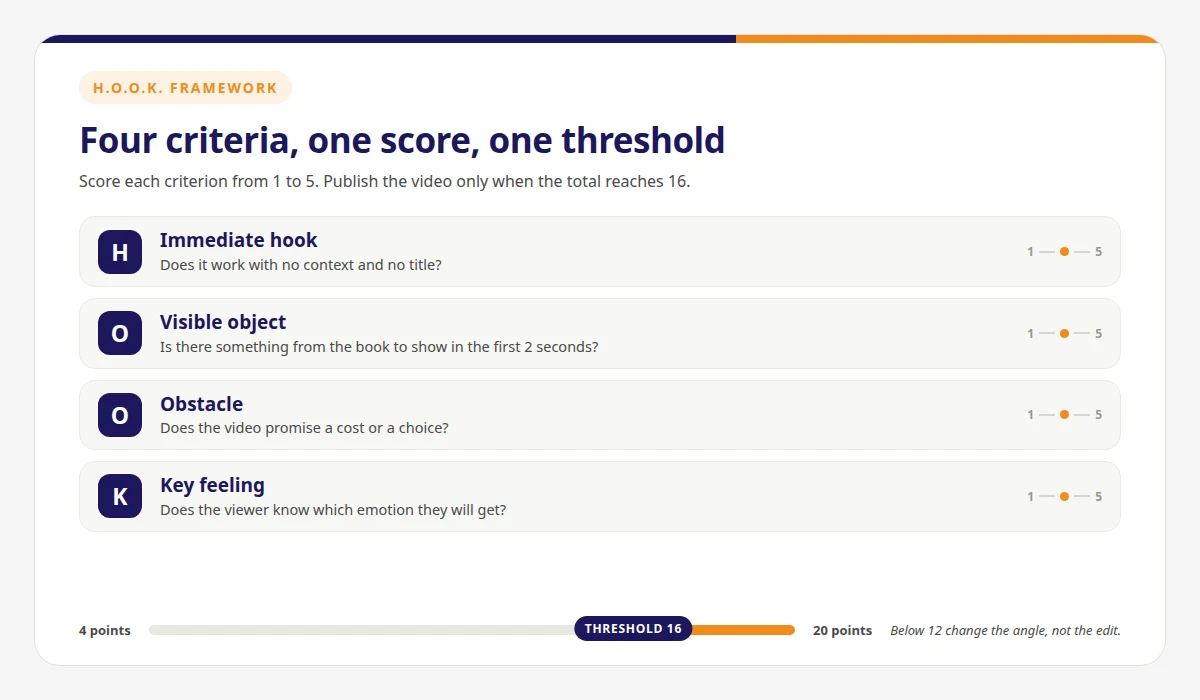
Here is the part that separates a BookTok strategy from a list of tips. The practical problem is not filming thirty videos, it is writing thirty different openings for the same book without repeating yourself by day nine. The H.O.O.K. framework decides in thirty seconds whether an opening deserves publishing or rewriting, before the camera is on.
The method scores four criteria from 1 to 5, for a total between 4 and 20. The publishing threshold is 16. Below that, the video is not ready, and the difference between an account that grows and one that stalls sits in this selection far more than in the editing.
| Criterion | Control question | Score 1 | Score 5 |
|---|---|---|---|
| H - Hook | Does the first sentence make sense with no context, no title, no "hey guys"? | Needs a setup to mean anything | Stands alone and opens a question |
| O - Object | Is there something from the book to show in the first two seconds? | Only a face or a neutral background | A recognizable, specific object or scene |
| O - Obstacle | Does the video promise a cost, a tension, or a choice? | Describes a flat situation | Names a concrete stake |
| K - Key feeling | Does the viewer know what emotion they will get? | No identifiable emotion | A precise feeling, nameable in three words |
Two worked examples explain the criterion better than any definition.
| Opening | H | O | O | K | Total | Verdict |
|---|---|---|---|---|---|---|
| "Today I want to talk about my new novel, it just came out and I am very happy" | 1 | 2 | 1 | 1 | 5 | Rewrite from scratch |
| "POV: your best friend asks you to pretend to be her fiancé at her wedding, and your brother is the best man" | 5 | 4 | 3 | 5 | 17 | Publish |
The second opening scores 3 on obstacle because the stake is implied rather than stated: you can sense the disaster, but the video does not name it. One change, for example adding that the fake fiancé is the person you left three years ago, lifts the score to 19. That is the kind of refinement the framework makes visible, and the kind the eye tends to skip.
The thresholds of a BookTok strategy are three:
- 16-20: publish. The video is ready and another hour of editing will not improve it.
- 12-15: refine one criterion, the lowest scoring one. Usually it is the object, because authors film themselves instead of the book.
- 4-11: change the angle. This is not an editing problem, it is an idea problem, and no cut fixes it.
The test demands discipline, not creativity. Write ten openings in one sitting, score them the same day, and publish only the ones above the threshold. If you notice yourself adjusting a score to justify a video you like, the method has already stopped working. Its value is that the decision happens before filming, when changing your mind costs nothing.
Cadence: thirty videos before you judge
Cadence is the least creative part of a BookTok strategy, and the one that decides the results. One post a day for thirty days beats three posts a day for a week followed by silence. The reason is mechanical: every video is a separate test, and you need enough tests to tell a format problem from a run of bad openings. Thirty posts is roughly where patterns become readable.
Production happens in one afternoon. Most authors who sustain this rhythm film six to eight videos at once, keep them in drafts, and spend ten minutes a day posting and replying to comments. Batching is not a productivity trick: it is how you stop deciding every morning whether to publish.
The month of a BookTok strategy splits like this:
- 10 trope reveals, rotating different combinations instead of repeating one list.
- 8 POV hooks, one per scene or character that can be pitched in a line.
- 7 aesthetic edits, built from the cover palette, the setting, and recurring objects.
- 5 vlogs, one per stage: outline, draft, revision, proof copy, a reader's message.
Do not plan month two before month one is finished. The point of thirty videos is to tell you what month two should be, and data from an unfinished month says nothing.
Sounds, the Bestseller List, and TikTok Shop in Italy
In a BookTok strategy, trending sounds are a distribution shortcut, not a creative strategy. Use a rising sound when its emotional shape matches the video, skip it when it does not: a trend glued to unrelated content is obvious and reads as desperation. The practical rule is to keep a folder of sounds saved while scrolling and check whether a sound is still climbing or already past its peak before building a video around it.
TikTok Shop changed the economics for anyone holding their own stock. In Italy it has been live since 31 March 2025 and had more than 21,000 active sellers at its first anniversary, with shoppable videos and LIVE shopping accounting for 38% and 20% of revenue respectively since launch (TikTok Newsroom). For an author with boxes at home it compresses the gap between video and purchase to one tap. It also means handling shipping, returns, and margins, which is a different job from writing.
Authors who sell mostly ebooks can stay with a link in bio, the simpler option in a BookTok strategy. Either way the link should land on a page you own, with every book, a sample chapter, and a way to leave an email address. The traffic from one good video is the only asset that outlives the video, and that is why an author page beats a list of store links.
The Bestseller List adds a physical channel: titles that enter the monthly ranking can carry official #BookTok stickers in bookstores. For an independent author it means a video can produce a visible effect in a shop, if the book is distributed. If you sell only online, the effect stays digital and still works as a legitimacy signal in the following weeks.
Working with creators without burning budget
Paying creators is where a BookTok strategy speeds up, and also where budgets disappear fastest. It is legitimate and often faster than building an account from zero. It is also where author budgets disappear without results. Four rules separate a sensible spend from a wasted one.
The first is to look at the shelf, not the follower count. A creator with 8,000 followers who reads only dark romance outsells a general creator with 200,000. Read their last twenty videos and ask whether your book would look at home there, with the same graphics and the same tone.
The second is to send the book, not the script. Prescriptive scripts produce videos that feel like ads and perform like ads. Give the trope list, the content warnings, and one line about the vibe, then let the creator work for the audience they know.
The third rule of a BookTok strategy with creators is to buy a series, not a post. One video from one creator is a coin flip. Three or four videos from different creators in the same two weeks is a signal that a book is circulating, and that is what makes viewers save it. The fourth is to agree on disclosure before money moves: paid partnerships must be labeled, and a clear label protects the creator and you.
Gifted copies to reviewers sit next to this work, not instead of it. BookTok builds desire, reviews convert it. If that side is still missing, the guide on how to sell books on Amazon covers the part that happens off-platform.
Five mistakes that stall a BookTok strategy
The first mistake is selling in every video. An account that only pitches teaches the algorithm to show it only to existing followers, and it stops growing. Roughly one video in four should sell; the rest should be worth watching even for someone who will never buy.
The second is filming a summary instead of a feeling. Plot summaries are the most common author video and almost never the most effective one. Readers do not choose a book from the sequence of events, they choose from the emotion they imagine feeling.
The third is deleting videos that underperform. On this platform a video can resurface weeks later, and deleting it removes both the tail and the data you needed to understand what happened. Give it at least thirty days.
The fourth is ignoring comments after the first twenty-four hours. Late comments are where slow distribution continues, and replying keeps a video alive far longer than posting a new one. The fifth is rebuilding the account every six weeks: changing name, niche, and format because one month was flat destroys the only thing you were accumulating, which is recognition. Give a BookTok strategy thirty posts before changing it.
What to measure instead of views
Views are the least useful number for judging a BookTok strategy, because they count a pass, not an interest. Four metrics tell you what to do next week, and the table puts them in order of usefulness with a practical threshold and the matching action.
| Metric | What it says | Practical threshold | What to do |
|---|---|---|---|
| Watch-through | Share of viewers who reach the end | Below one third | Shorten the video before changing anything else |
| Saves | The closest thing to purchase intent | Rising while views fall? | Make three more videos in the same format |
| Comment content | Whether the audience is buying or just laughing | Questions about the title | Put the title in the pinned comment and the next video |
| Link taps | The only bridge between platform and business | Flat weekly trend | Change the landing page, not the video |
None of these numbers mean anything alone. Read them across a full cycle of thirty posts and treat a flat week as noise, not a verdict. The question is not how many people watched, but how many did something countable.
How to produce thirty pitches with AI
The bottleneck in a BookTok strategy is not filming. It is producing thirty distinct pitches for one book without repeating yourself. That is a language problem, and it is the part you can genuinely speed up with AI, provided you start from the manuscript and not from a vague memory of the plot.
Inside Books Maker the book already exists as chapters, characters, and an outline, so pitches come from the actual text. In practice you can ask for a list of scenes that contain an irreversible choice, pull a POV hook for each one, extract the opening lines of the strongest chapters for read-aloud videos, and get ten trope combinations that match what you wrote rather than what you wish you had written.
The useful way to use these tools in a BookTok strategy is to measure, not delegate. Ask three concrete questions per scene: what is at stake, what does the character lose by refusing, and which sentence can be read aloud with no context. The answers feed the four criteria of the H.O.O.K. framework, and you assign the score.
To see the whole path, from premise to publication, see how Books Maker works. For a wider launch plan, the guide on how to promote a book on social media covers the channels outside BookTok.
Frequently asked questions
How many followers do you need to sell books on BookTok?
A BookTok strategy does not need a large audience. An account with 2,000 followers and a coherent audience outsells a general account with 100,000. The number that matters is the share of viewers who watch to the end and save the video.
Do you have to show your face on BookTok?
No. Trope reveals, aesthetic edits, and first lines read in voiceover work without appearing. A face builds familiarity and helps more if you want to sell the next book to the same audience, but it is not a requirement.
Does BookTok work for nonfiction?
Rarely as a primary channel. Technical nonfiction is chosen through search and credibility. It works when the thesis can be told as a personal story, for example in a memoir or narrative nonfiction with a concrete stake.
How long should a BookTok video be?
Between 7 and 20 seconds for discovery formats, between 30 and 60 for vlogs. Cut until watch-through stays above one third. A short, complete video beats a longer one with three seconds of throat-clearing.
Can I reuse the same videos on Reels and Shorts?
Yes, with a native version per platform: same edit, new on-screen text, and a caption written for that audience. Uploading the identical file to three platforms on the same day makes it read as automated advertising.
How much does it cost to work with a BookTok creator?
In Italy a micro creator between 5,000 and 30,000 followers typically charges 150 to 600 euros per video, while creators above 100,000 followers start around 1,000 euros. A free copy only works with someone who already reviews your genre, and three videos across two weeks beat a single post.
Conclusion
A BookTok strategy in 2026 is thirty ordinary videos, five formats, an opening that respects the viewer's thumb, and a link that leads somewhere you control. There is no shortcut past the volume, because the volume is the experiment. Authors who look lucky are almost always the ones who posted long enough to find out which two formats their book was built for.
A BookTok strategy is judged on the first thirty videos, not the first. Pick your five formats this week, score the first ten openings with the H.O.O.K. framework, and film on Saturday. If an opening does not reach 16, rewrite it instead of editing it better. Once you have thirty posts of data, you will know which format to repeat and which to drop, and month two will cost half the effort.
Keywords: BookTok strategy, BookTok, BookTok Italy, TikTok for authors, promote a book on TikTok, trope reveal, POV hook, aesthetic edit, H.O.O.K. framework, hook, watch-through, saves, TikTok Shop, BookTok Bestseller List, creator, romantasy, self-publishing, book marketing, shoppable video, backlist
About Books Maker: Our team is made up of AI professionals. Together with expert writers and authors, we created booksmaker.ai to help our users achieve their publishing dreams by leveraging the power of Artificial Intelligence tools for every stage of the process, from idea to book creation.
Related articles
- How to promote a book on social media
- How to sell books on Amazon
- How to create a book outline
- How to write a story
- How to write a fantasy novel
More questions? Read our full FAQ on creating books with Books Maker for answers on features, pricing, and publishing.
Share this article
Start creating your book with AI
Use Booksmaker.ai to turn your idea into a published book, chapter by chapter.
Start for free