Freytag's Pyramid: guide to five-act story structure
Freytag's Pyramid explained through its original terms: the five acts, the centered climax, how it differs from three-act structure, and the 50% test to check whether your story holds.
Stay updated with our newsletter
Receive exclusive tips, resources, and updates to turn your ideas into bestselling books.
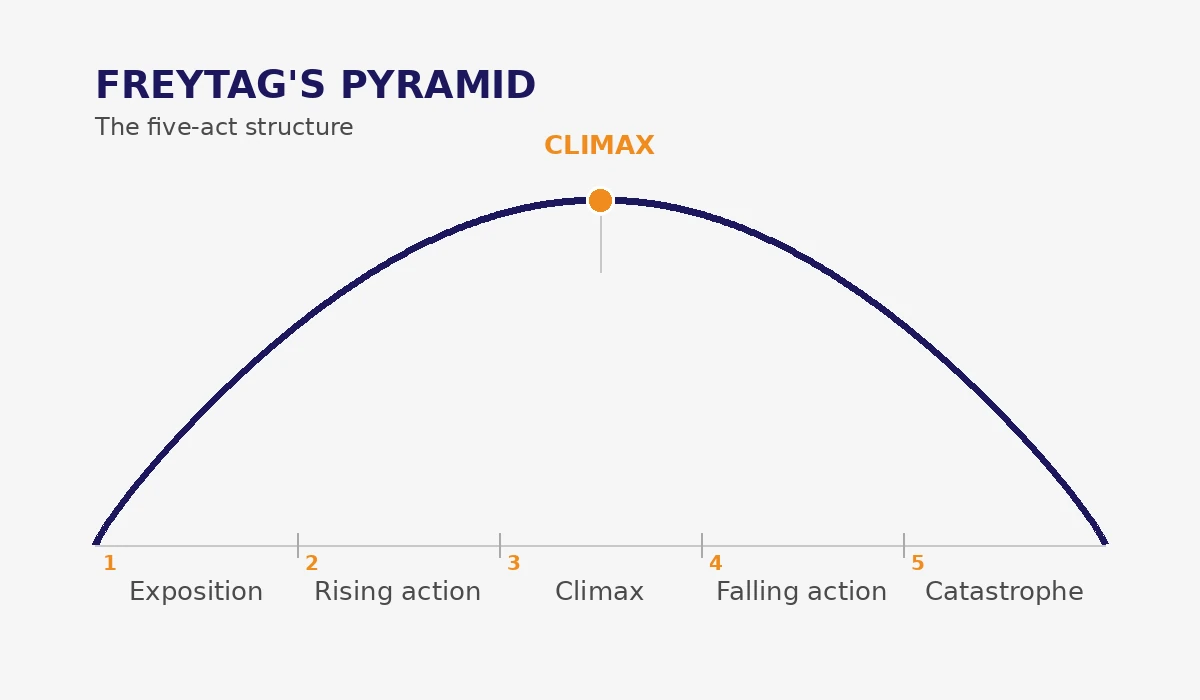
Freytag's Pyramid is the five-part model that Gustav Freytag derived in 1863 from Greek tragedy and Shakespeare: exposition, rising action, climax, falling action, catastrophe. The detail almost every classroom version drops is the position of the turning point, which sits at the center of the story rather than at the end. Everything about how the second half works follows from that placement.
Most writers meet Freytag's Pyramid as a mountain drawn on a whiteboard: a climb, a peak, a descent. That picture is only partly right. Freytag was not describing a universal template for novels of every genre. He was describing one form, the five-act tragedy, and he offered it as an observation rather than a recipe. Over time the diagram was simplified, the catastrophe was renamed "resolution," and the peak drifted toward the end. The result is a model that resembles neither Freytag nor most books published today.
This guide returns the model to its original terms and shows where it still works. You get the five acts explained one at a time, Macbeth as a worked example, a table comparing the pyramid with three-act structure and the hero's journey, and a three-question test with numerical thresholds to check whether your manuscript actually has that shape. By the end you will know when to use it and, more importantly, when to leave it alone.
Table of contents
- Key definitions
- Where Freytag's Pyramid comes from
- The five acts, one at a time
- Macbeth mapped onto the pyramid
- Freytag's Pyramid, three acts, and the hero's journey
- The 50% test: three questions and three thresholds
- When to use it and when not to
- Four mistakes that break the structure
- How to check structure with AI
- Frequently asked questions
Key definitions
Before the model itself, a few terms need fixing. Freytag's Pyramid uses words that carry more than one meaning in narrative theory, and that ambiguity is exactly what produced the different classroom versions.
Freytag's Pyramid: a five-part story model published by Gustav Freytag in Die Technik des Dramas in 1863, derived from Greek tragedy and Shakespeare's plays.
Centered climax: the turning point placed at the middle of the work, where the protagonist's fortune reverses. It is not the loudest scene, it is the decision you cannot undo.
Rising action: the sequence of complications that makes the central turn inevitable. Freytag called it Steigerung, intensification.
Falling action: the section after the climax that shows the consequences of the turn. Freytag called it fallende Handlung and insisted it needed suspense of its own.
Catastrophe: the ending in which the announced fall happens. The modern version replaces it with the dénouement, which is a different thing.
Where Freytag's Pyramid comes from
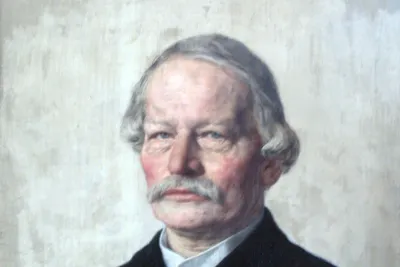
Gustav Freytag (1816-1895) was a German novelist and man of the theatre, not an abstract theorist. He spent years reading Aeschylus, Sophocles, and Euripides alongside Shakespeare's history plays, looking for the shared skeleton that made those works land on stage. The answer came in 1863 with Die Technik des Dramas, a practical manual for people writing for the theatre. The encyclopedia entry on the model summarizes the sequence and its origin (Freytag's pyramid, Wikipedia).
His claim was narrow. A well-built five-act tragedy passes through five moments, and the turn happens in the middle. The line climbs through complication after complication, reaches the point where the protagonist's fortune reverses, then descends through the consequences to the ending. Freytag called the figure a "comparison," a way of visualizing the movement of the action, and warned against treating it as a blueprint to trace. That warning disappeared from the school versions, where the diagram became a grid with five boxes to fill.
A second difference is worth flagging. Freytag did not write about rising and falling action as neutral pacing zones. He wrote about a rise and a return, driven by the hero's own choices, ending in catastrophe. Remove the tragic dimension and what remains is a bell curve: an opening, a climb, a peak, a drop, a close. That is roughly what happened to the diagram on its way into textbooks, and it explains why so many modern versions feel both obvious and useless.
The five acts, one at a time
Freytag used five German labels. They appear here next to the English names most writers know, because the choice of words changes how the model reads.
1. Exposition (Einleitung)
Exposition establishes the world, the protagonist, and the balance about to break. Freytag treated it as one strong scene rather than a chapter of background: a few facts, all of them needed to understand what is at stake. The section ends with what he called the exciting force, the event that pushes the character off their normal path.
The usual mistake is piling up family history and geography before anything happens. Readers tolerate a paragraph of context, not a chapter. If three pages in you still cannot say what the protagonist wants, the exposition is too long.
2. Rising action (Steigerung)
Here the conflict takes shape and each complication raises the stakes. Rising action is not a list of misfortunes. It is a chain in which every choice narrows the options that follow. The protagonist tries a solution, the solution creates a new problem, the problem forces another choice.
Freytag insisted the climb should be longer than the descent. In practice that means more scenes before the climax than after, and every scene should make a return to the starting position slightly more expensive.
3. Climax (Höhepunkt)
The climax is the top of the arc and, at the same time, the point of no return. It is not necessarily the most spectacular scene. It is the scene where the protagonist makes a decision, or receives a revelation, that makes going back impossible. If the character could still walk away afterwards at no cost, you have written a complication, not a climax.
In classical tragedy the climax often coincides with the hero's greatest success rather than their defeat. Macbeth reaches the throne, believes he is safe, and starts losing everything from exactly that point. That inversion is the core of the model and the reason it works best with stories of downfall.
4. Falling action (fallende Handlung)
Consequences arrive after the turn. Freytag was explicit that the second half cannot simply explain what already happened. It needs tension of its own. He even named the device: a moment of last hope for the doomed protagonist, which gives the audience the illusion of an exit before the catastrophe.
In Macbeth that moment is the witches' second prophecy, promising safety until Birnam Wood moves and until a man not born of woman faces him. The reader knows those words are a trap, the protagonist does not, and the gap between the two kinds of knowledge produces the suspense.
5. Catastrophe (Katastrophe)
The catastrophe is the ending in which the announced fall takes place. It is not an accident, it is the payment of a debt taken on in the first act. Freytag considered it the hardest part, because after the turn the audience tends to relax, and the ending has to arrive as inevitable without feeling arbitrary.
The modern version replaces the catastrophe with the dénouement and softens the ending. That is a legitimate change for other genres, but it changes the shape: a story that ends in victory or compromise does not have the same curve as one that ends in loss.
Macbeth mapped onto the pyramid
Freytag built the model on plays like this one, and Macbeth follows it with almost suspicious precision. It is also the fastest way to see where a centered climax works and where it creates problems.
- Exposition. A victorious general meets three witches who greet him as the future king. The exciting force is the prophecy. Nothing has happened yet, but ambition has just received permission.
- Rising action. Lady Macbeth pushes, Duncan is murdered, Banquo is murdered to protect the secret. Each act of concealment requires the next one. Macbeth is winning and losing at the same time.
- Climax. The banquet scene, in act 3 of 5, when Banquo's ghost appears and Macbeth breaks down in front of his own court. Nobody duels. This is the turn: from here he can only be found out.
- Falling action. The nobles change sides, Lady Macbeth unravels, the second prophecy gives Macbeth a false sense of safety, and the English army advances.
- Catastrophe. Birnam Wood comes to Dunsinane, the man not born of woman kills him, Malcolm takes the crown. The order broken in act one is restored.
Notice where the peak sits: halfway through, in the middle act of five. A modern thriller with its turning point at 50% would feel like it ends twice. That distance is exactly why the model works for tragedy and badly for genre fiction.
Freytag's Pyramid, three acts, and the hero's journey
The three models are often presented as the same structure with different labels. They are not. The table compares them on origin, position of the turning point, weight of the second half, and the genre where each works best. Those are the four criteria that change decisions while you draft.
| Model | Position of the turning point | Weight of the second half | Best genre | Main risk |
|---|---|---|---|---|
| Freytag's Pyramid | At the center, around 50% | About half the book | Tragedy, literary fiction, stories of downfall | A second half that only explains |
| Three-act structure | Near the end, around 85-90% | Short, usually 10-15% | Thriller, mystery, romance, commercial fiction | A second act that expands without turns |
| Hero's journey | Crisis and reward in the third quarter | Variable, with return and change | Fantasy, adventure, coming of age | Beats filled in out of duty |
The practical difference is this. If you are writing a story where the protagonist has to understand something and the understanding arrives at the end, Freytag's Pyramid pushes you to reveal it too early. If you are writing an announced downfall, three-act structure keeps the character standing until nearly the last chapter, and the fall loses weight.
The hero's journey describes inner change more than the arrangement of events. You can use it alongside the pyramid: the pyramid organizes the plot, the hero's journey organizes the character's transformation. They are complementary tools, not alternatives. For a closer look at the models most commercial fiction relies on, the guide on how to write a story covers scenes, conflict, and pacing.
The 50% test: three questions and three thresholds
At this point the useful question is not "does my story follow Freytag's Pyramid?" but "does the shape I chose hold?" The test below answers with measurements instead of impressions. It works on a finished manuscript or a detailed outline, takes ten minutes, and produces three numbers.
Question 1. Where does the irreversible decision fall? Take the page, or the percentage of words, where the protagonist makes the choice they cannot undo. Divide by the total length of the manuscript.
- Between 45% and 55%: the story has a pyramid shape.
- Between 70% and 90%: the story follows three-act structure.
- Below 35%: the story is episodic, or the turn you identified is not the main one.
Question 2. Is the turn actually irreversible? Try to imagine the protagonist returning to the starting situation immediately afterwards without paying a price. If they can, the scene is a complication, not a climax. The criterion is not emotional intensity, it is the cost of going back.
Question 3. How much does the second half weigh? List the scenes after the turn and mark the ones that introduce a new obstacle or a new cost. If they are less than 40% of the total, the second part is confirming a fall already written, and the book has an ending that stretches.
Applied to three works with known structure, the test gives different and useful results.
| Work | Identified turn | Position | Outcome |
|---|---|---|---|
| Macbeth | Banquet with Banquo's ghost, act 3 scene 4 | About 50% | Passes all three questions |
| Romeo and Juliet | Killing of Tybalt, act 3 scene 1 | About 50% | Passes all three questions |
| And Then There Were None | Final revelation in the manuscript | Beyond 95% | Not a pyramid: a mystery with a late solution |
The Macbeth case is the cleanest. The second half contains Malcolm's army, the murder of Macduff's family, Lady Macbeth's sleepwalking, and the arrival of Birnam Wood: every scene adds an obstacle rather than commenting on one already passed. And Then There Were None shows why the model should not be forced. The novel lives on a question held open until the final page, and moving the solution to the center would have destroyed the mechanism.
If your score does not line up, you have two options. You can move the turn by reordering scenes, or you can change models and accept that the story has a different shape. The second option is often the more honest and the faster. To work on scene order before drafting, the guide on how to create a book outline offers a seven-step method compatible with this test.
When to use it and when not to
Freytag was describing a form, not prescribing a method. Treated that way, the pyramid stays useful.
Reach for it when:
- You are writing tragedy, literary fiction, or any story whose ending is a consequence rather than a reward.
- The protagonist ruins themselves through their own choices. The rise-and-return curve is built for exactly that.
- You are analyzing a finished work. The pyramid is an excellent diagnostic even for books that were never designed with it.
- You want to test whether the second half of your draft carries real tension or is only tying knots.
Skip it when:
- You are writing thriller, romance, mystery, or anything where readers expect the peak late. A centered climax leaves half the book after the answer.
- The story is a series entry that has to end on an unresolved thread. Freytag's fifth stage assumes closure.
- You are using it as a drafting template rather than a description. Its five parts are unequal in length, and the symmetrical diagram hides that.
- Your genre runs on a mystery engine, where the reveal has to sit close to the final page.
Four mistakes that break the structure
The first mistake is reading the diagram as a timeline. The pyramid is symmetrical because it is a drawing, not a schedule. Freytag himself treated the introduction as brief and the climb as long. Spacing your five stages evenly across a novel produces a saggy opening and a bloated ending.
The second is putting the biggest set piece at the top. The climax is a reversal of fortune, not an explosion. Macbeth's climax is a dinner party with a ghost: no duel, no army, just a man exposing himself in front of his own allies. If your peak is the loudest scene instead of the most consequential one, the structure is mislabeled.
The third is letting the falling action deflate. Freytag was explicit that the second half needs its own suspense, and he named the device: a moment of last hope for the doomed protagonist. Without it, readers coast through the final act. The guide on how to end a book goes deeper into keeping that stretch alive.
The fourth is applying the model to a genre it was never built for. This is the expensive one. A mystery plotted on Freytag's Pyramid reveals its culprit at the midpoint, and the rest of the book becomes an explanation. The model is not wrong. It is describing a different kind of story.
How to check structure with AI
Structure problems are cheap to fix in an outline and expensive to fix in a manuscript. In Books Maker you describe your book and generate a chapter-by-chapter outline, then edit any chapter summary and regenerate around it. In practice you can move the turning point, test a centered peak against a late one, and see how the chapter count redistributes before a single scene is written.
The useful way to use these tools is to measure, not to delegate. Ask three concrete questions: which chapter contains the irreversible decision, how many scenes after that decision introduce a new obstacle, and what would happen if the protagonist tried to walk back. The answers give you the numbers for the 50% test right away.
To see the full path from premise to publication, see how Books Maker works. For conflict and scene construction, the guide on how to write a thriller shows how tension is distributed in a genre built on a late climax.
Frequently asked questions
What is Freytag's Pyramid in short?
A five-part model derived by Gustav Freytag in 1863 from Greek tragedy and Shakespeare: exposition, rising action, climax, falling action, and catastrophe. The turning point sits at the center of the story.
Why is the climax of Freytag's Pyramid in the middle?
Because Freytag was describing classical tragedy, where the protagonist reaches maximum power or success halfway through and cannot go back. The second half pays for that turn.
What is the difference between Freytag's Pyramid and three-act structure?
The position of the irreversible moment. In the pyramid it falls around 50%. In three-act structure it falls around 85-90%, followed by a short resolution.
Does Freytag's Pyramid work for a thriller or a mystery?
Rarely. Those genres need peak tension near the end. With a centered climax the solution arrives halfway through and the second part loses its function.
How do you calculate the position of the turning point?
Divide the page, or the percentage of words, where the irreversible decision happens by the total length of the manuscript. Between 45% and 55% you have a pyramid, between 70% and 90% you have three acts.
Is Freytag's Pyramid still useful today?
Yes, as an analytical tool. It checks whether the middle of your story produces a real turn and whether the second half carries tension of its own instead of explaining what already happened.
Conclusion
Freytag's Pyramid describes one precise shape: the self-inflicted fall, turning at the center, paid for across the second half. Used as a lens it will tell you things about your manuscript that no beat sheet can. Used as a template for a commercial novel it will hand you a book that peaks halfway and then explains itself for two hundred pages.
The best way to decide is to measure. Identify the irreversible decision, calculate where it falls, check whether going back is truly impossible, and count how much of the second half introduces a new cost. If the numbers do not match the model you had in mind, you have found something useful before revision, not after.
Keywords: Freytag's Pyramid, five-act structure, story structure, centered climax, rising action, falling action, catastrophe, turning point, Gustav Freytag, Die Technik des Dramas, Macbeth, three-act structure, hero's journey, 50% test, book outline, plot, tragedy, mystery, thriller, ending
About Books Maker: Our team is made up of AI professionals. Together with expert writers and authors, we created booksmaker.ai to help our users achieve their publishing dreams by leveraging the power of Artificial Intelligence tools for every stage of the process, from idea to book creation.
Related articles
- How to create a book outline
- How to write a story
- How to end a book
- How to write a thriller
- POV switching in a novel
More questions? Read our full FAQ on creating books with Books Maker for answers on features, pricing, and publishing.
Share this article
Start creating your book with AI
Use Booksmaker.ai to turn your idea into a published book, chapter by chapter.
Start for free