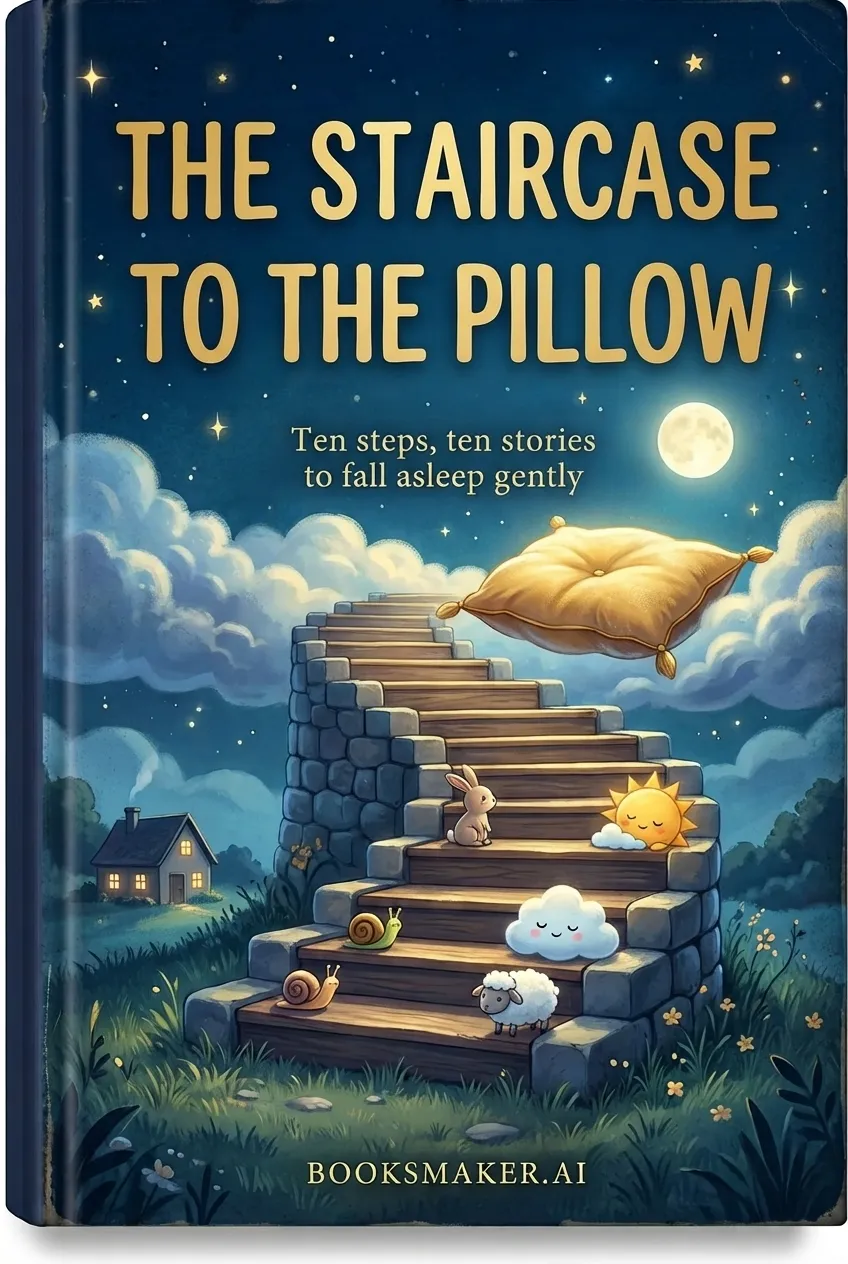
La scala verso il cuscino
by Booksmakerai
English · Complete
Fairytales and legends · Preschool (0-5 years)
Quando la giornata finisce e le voci si fanno piano, compare una scala speciale: ha dieci gradini, e su ciascuno aspetta una storia.
Lino, il coniglietto, ascolta i rumori della notte. Nina la lumachina attraversa il prato senza fretta. Una pecora conta le sue amiche, una nuvola guarda la festa dall’alto e una stella bambina scopre che il cielo è pieno di piccole luci. Poi la sera rientra in casa, tra scale che scricchiolano, bolle nella vasca e copertine da rimboccare.
La scala verso il cuscino raccoglie dieci racconti dolci e rassicuranti, da leggere ad alta voce un gradino alla volta. Con parole semplici, ritornelli da ripetere insieme e paure piccole che trovano il loro spazio, ogni storia accompagna grandi e piccoli dal chiaro della sera al silenzio della notte.
Una lettura da condividere, per fare della buonanotte un momento caldo, lento e pieno di meraviglia.
English When the day comes to an end and voices grow soft, a special staircase appears: it has ten steps, and a story is waiting on each one.
Lino the little bunny listens to the sounds of the night. Nina the little snail crosses the meadow without rushing. A sheep counts her friends, a cloud watches the party from above, and a baby star discovers that the sky is full of little lights. Then evening comes back indoors, amid creaking stairs, bubbles in the tub, and blankets to tuck in.
The staircase to the pillow brings together ten sweet, reassuring tales to read aloud one step at a time. With simple words, refrains to repeat together, and small fears that find their place, every story guides grown-ups and little ones from evening twilight to the quiet of night.
A story to share, turning bedtime into a warm, unhurried moment full of wonder.
First chapter
Stories of Little Animals
Once upon a time there was a little rabbit named Lino.
Lino had white and gray fur. He had long, soft ears. A tousled little tuft fell over his forehead.
His home was a burrow beneath an apple tree. Inside there was a bed of leaves. On top of the bed there was a wool blanket.
That evening Lino returned to the burrow while the sky was still light.
—Mom, I’m home, —he said.
But Mama Rabbit wasn’t there.
She had gone out to gather tender grass for dinner. She had told him she would be back soon.
Lino sat down on the bed of leaves.
He waited.
The burrow smelled of fresh earth and apple. Near the entrance there was a dry leaf. Lino moved it with one paw, then sat down again.
He looked around. There was a smooth little pebble on the floor. Lino nudged it with the tip of his paw. It rolled to the edge of the bed and stopped.
He picked it up and put it beside the entrance, where it wouldn’t get in anyone’s way.
Near the bed there was a little root poking out of the earth. Lino knew it well: during the day he used it as a step to climb onto the bed. He touched it with one paw and felt how rough it was.
—Good evening to you too, —he said to the root.
Then he sat on the blanket and let his paws dangle.
Outside, the sun sank behind the trees. The meadow turned dark green. The sky turned blue. Then the blue grew deeper and deeper.
Lino pulled the blanket over his knees.
He waited some more.
There wasn’t much light in the burrow. Lino looked at the entrance. He couldn’t see Mama Rabbit.
So he clutched the blanket with his little paws.
—She’ll be back soon, —he whispered.
Lino ran one paw along the edge of the blanket. The wool was rough on one side and smooth on the other, because Mama had mended it carefully. Lino knew that little thicker patch. He rubbed it between his fingers, gently, as he listened.
From the burrow he could see a little patch of meadow. A blade of grass bent and then straightened again. An apple-tree leaf moved just a little. Lino tried to guess where Mama was, but he couldn’t see anyone.
He got up to look more closely. He took two steps toward the entrance and stopped. Outside, the sky was still light in the distance, but above the trees it was growing dark. Lino went back to the bed and sat in his place.
The blanket slipped down a little. He pulled it back over his knees.
—She’ll be back soon, —he repeated, more softly.
Lino made himself more comfortable on the bed. The dry leaves rustled softly beneath his weight. He moved one that tickled his side and put it beside his moss pillow. Then he smoothed the blanket over his knees, first on one side and then on the other.
Near the entrance, the pebble he had set aside gleamed faintly in the remaining light. Lino looked at it and thought it looked like a little gray moon. He didn’t pick it up: it was already in its place, out of the way.
A scent of apple rose from the earth beneath the roots. Lino breathed it in slowly. The burrow was his home, with its bed, blanket, rough root, and pebble by the door. He remembered that Mama knew the way and had told him she would be back soon.
Lino rested his paws on the blanket and waited, listening to the silence between one rustle and the next.
The first sound came from the apple tree.
Frrr, frrr.
Lino’s eyes flew open.
Something was moving outside the burrow.
Frrr, frrr.
Lino curled up under the blanket.
—Who’s there? —he asked softly.
The sound came again.
Frrr, frrr.
Lino listened without moving.
The wind was passing through the apple-tree leaves. The leaves touched one another and said hello.
Frrr, frrr.
—It’s the wind, —said Lino.
The blanket slipped a little off his ears.
The wind blew softly. The leaves rustled again.
Lino listened. The sound didn’t hurt. It was only the apple tree moving in the wind.
—Good evening, apple tree, —he said.
The apple tree didn’t answer. It only went frrr, frrr.
Lino stayed sitting on the bed of leaves.
He waited.
Night drew near the burrow. Another sound sprang out of the grass.
Cri, cri.
Lino froze.
The sound came from near the entrance.
Cri, cri.
Lino wrapped himself in the blanket.
—Mama? —he called.
No one answered.
Lino listened again.
Cri, cri.
Then he saw a small shadow standing still between two blades of grass.
It was a cricket.
The cricket rubbed its wings together and sang to the evening.
Cri, cri.
—Is that you, Cricket? —Lino asked.
Cri, cri, the cricket replied.
Lino gave a little smile.
—Your song is very small, —he said. —But I can hear it all the way over here.
The cricket sang again. Lino listened to its thin little voice. It sounded like a little song saying, “It’s evening, it’s evening, rest for a while.”
Lino stretched out on the bed of leaves.
The blanket warmed his paws. The cricket sang outside. The apple tree rustled above the burrow.
Lino closed his eyes.
Then he heard a third sound.
Tup.
Lino opened his eyes again.
Tup, tup.
Something had touched the blanket.
Lino clutched it tightly.
—Who’s there now? —he whispered.
Tup.
Lino stayed perfectly still.
Tup, tup.
The sound came from behind him.
Lino looked to the left. He didn’t see anything.
He looked to the right. He didn’t see anything.
Then he turned his head and saw his tail.
His soft tail was brushing against the blanket.
Tup, tup.
It was his tail moving while he trembled.
Lino touched it with one paw.
—Oh. It’s you, Tail.
The tail went still.
Lino stroked it gently.
—There’s nothing to be afraid of.
Outside, the wind went frrr, frrr. The cricket went cri, cri. And Lino’s tail didn’t go tup anymore.
Lino breathed slowly.
Inside the burrow it was dark, but it wasn’t an empty darkness. There was the bed of leaves, the warm blanket, and the lovely smell of earth. Outside there were the apple tree and the cricket.
Lino looked at the entrance.
The sky was dark now.
—Mama will come back, —he said.
And he waited a little longer.
The burrow was quiet for a moment. Lino rested one ear on the blanket and felt his heart beating softly.
Thump, thump.
It wasn’t a new sound. It was his heart, keeping him company while he waited.
Lino put one paw on his chest.
—I’m here, —he said softly.
He settled on the bed, his nose pointed toward the entrance. From there he could see a little part of the meadow. He couldn’t see the whole night, only a little patch of sky and a few blades of grass.
Lino counted the blades of grass moving gently.
One.
Two.
Then he stopped. He didn’t have to count anything. He could simply watch.
Then a thread of light came in through the burrow opening.
It was a moonbeam.
It slid across the earthen floor. It reached the bed of leaves. It settled on Lino’s blanket, bright and gentle.
Lino looked outside.
In the meadow, a firefly lit up its little light.
Then another lit up.
Then another.
One, two, three.
The fireflies shone among the grass like tiny light bulbs.
Lino stayed and watched them.
The moon was above the apple tree. It didn’t say anything. But its beam came into the burrow and kept Lino company.
—Good evening, Moon, —said the little rabbit.
The moon shone softly.
Lino followed the lights in the meadow with his eyes. One firefly landed on a blade of grass. Another flew a little farther away. The third lit up near the apple-tree roots.
They looked like little friends saying hello without waking anyone.
Lino heard the wind among the leaves. He heard the cricket in the meadow. He felt his breath going up and down.
Up and down.
Up and down.
The blanket came up to his nose.
Lino curled up. His ears rested softly on the blanket, one on one side and one on the other. The bed of leaves rustled just a little beneath him.
Outside, one firefly went dark for a moment and then shone again. Lino watched it without lifting his head.
The moonbeam stayed on the floor. The cricket sang once more. The apple tree answered with a rustle.
Lino no longer needed to wonder who was making those sounds. He knew them. The wind was in the apple tree. The song belonged to the cricket. The little tup had been his tail.
When Mama Rabbit came back, she was carrying a bunch of tender grass.
She entered the burrow quietly.
—Lino? —she called softly.
Lino was already asleep.
He was curled up on the bed of leaves, with the blanket up to his nose. A moonbeam lit one of his ears. Outside, the fireflies were still lighting up in the meadow.
Mama Rabbit put the grass near the entrance. She tucked in his blanket.
Lino gave a little sigh.
The moon stayed at the burrow window.
The apple tree rustled softly.
The cricket sang softly.
And Lino slept safe and sound.
“Darkness, darkness, I’m not afraid anymore: the moon tucks in my blanket for me.”
Nina was a little snail with a honey-colored shell.
The shell had a dark spiral, like a path that wound and wound. Nina always carried it on her back. It was her home, and her roof too.
One evening the meadow friends planned a snack.
—Come along too, Nina, —they said. —We’ll meet near the big yellow flower.
Nina smiled.
—I’ll come, —she replied.
Her friends set off right away.
Nina set off early, just as evening was beginning.
She knew she moved slowly. Very slowly. Step by step.
She settled her shell on her shoulders and put a cabbage leaf in her little bag. Then she came out from beneath her house leaf.
Before setting off, she looked at her green door. The leaf was broad and fresh, and its edge made a little shadow.
—I’ll be back after the snack, —said Nina.
Then she set off.
The meadow was big for a little snail.
In front of her were blades of grass as tall as trees. There were round stones like hills. There were paths winding around the roots.
Nina began to walk.
Before going any farther, she made sure the cabbage leaf was safely in her bag and checked that her shell was secure on her shoulders. The edge of the shell brushed her neck, but it didn’t bother her: it was her home, and it went everywhere with her.
The earth was cool beneath her foot. Nina left a shiny trail behind her, thin as a silver thread. She passed a dark clod of earth, then went past a round seed that looked like a tiny pebble. She didn’t pick it up; she only looked at it as the sky changed color above the grass.
A blade of grass brushed one of her feelers. Nina stopped, let it sway, and waited for it to return to its place. A little farther on was a broad leaf with a little drop on its edge. The drop trembled, but stayed put. Nina greeted it with a nod and continued on her way.
Every now and then she stopped to see how far she had come. Her green home was now tiny behind her, but the path was still clear. Nina wasn’t worried: she knew the way and could follow it back.
—Slowly, slowly, step by step, —she said. —The whole meadow is right here.
The first step was small.
The second was even smaller.
The third brought her beside a closed flower.
Nina stopped.
The flower’s petals were pressed tightly together. It looked as if it were asleep.
—Good evening, Flower, —said Nina.
The flower didn’t move.
Nina waited.
She knew how to wait. It was something she was good at.
She waited a moment.
She waited another moment.
She looked at the tip of a petal. It was smooth and closed. Then she looked at the stem, thin and still.
The meadow wasn’t in a hurry. Neither was Nina.
She waited some more.
Then the flower moved just a little.
One petal opened.
Then another.
Then another.
The flower slowly woke up, right in front of Nina.
Nina watched the petals open in the evening light. They were yellow in the middle and pale around the edges.
—How lovely, —she said.
The flower cast a little shadow over her for a moment.
Nina continued on her way.
Slowly, slowly.
Step by step.
After a while she saw a drop of water hanging from a blade of grass.
The drop was round and shiny. Inside it was a little piece of sky.
Nina came closer.
One step.
Then another.
The drop trembled.
Nina stopped.
The drop slid slowly down the green blade.
Down, down, down.
Nina followed the drop with her eyes.
The drop reached the tip of the grass. It stayed there, hanging like a little bead.
Nina stretched out a feeler to touch it.
Plink.
The drop fell onto a leaf.
Nina laughed.
—Plink, plink, —she said. —What a little splash.
The leaf swayed, but the drop stayed in place.
Nina watched the drop shine on the leaf. The moon, which had just appeared above the meadow, was reflected on its shiny surface.
For a moment Nina stayed there, still, watching that little circle of light.
Then she continued on her way.
Slowly, slowly.
Step by step.
The meadow looked different up close. There were roads between the roots. There were little doorways beneath the leaves. There were tiny footprints in the soft earth.
Nina followed a path that went between two stones.
There she found a snail asleep.
The snail was curled up inside its shell. All you could see was the spiral and a little patch of moss.
Nina walked even more slowly.
—Rest well, —she whispered.
The snail didn’t wake up.
Nina stopped beside it and looked at the moss. It was soft and green. There were two grains of earth on the shell.
—I’ll keep the path clear for you, —said Nina.
Then she passed by without making a sound.
Slowly, slowly.
Step by step.
Sometimes the path climbed over a root. Sometimes it dipped down into a little crease in the earth. Nina didn’t hurry. She stopped whenever she found a shiny pebble or a heart-shaped leaf.
Then she set off again.
Slowly, slowly.
Step by step.
Once, a little leaf fell in front of her. Nina looked at it closely. It had a rounded tip and a thin vein running down the middle.
She picked it up and put it beside her cabbage leaf in her bag.
—That way I’ll have a memory of the journey, —she said.
Then she went on, leaving a shiny trail on the earth.
Along the path, Nina passed between two blades of grass that touched overhead. To her they looked like a green doorway. She went through the doorway and stopped for a moment on the other side.
She turned to look at it.
—What a lovely path, —she said.
The shiny trail she had left behind her gleamed faintly. Nina followed the trail with her eyes, then looked ahead.
The evening grew darker. The moon rose above the meadow, and its light fell between the blades of grass.
Nina looked up.
The moon looked down at her with its peaceful face.
—I’m on my way, —said Nina.
And she continued on her way.
Slowly, slowly.
Step by step.
When Nina arrived at the big yellow flower, her friends were gathering up the last crumbs from their snack.
But they hadn’t gone away.
—Nina! —they said. —You made it!
—We waited for you, —said a little ant.
—Sit down beside us, —said a ladybug.
They made room for her on a broad leaf. Nina sat down with her shell resting securely.
The leaf was cool and a little curved, like a bowl. Nina set her bag beside her and took out the cabbage leaf she had brought. She put it on her knees, but didn’t take a bite right away. The path, the open flower, and the shiny drop were still in her mind’s eye.
Her friends offered her a soft crumb. Nina took it gently and put it beside the cabbage leaf. The ladybug made room for her with a light step; the little ant pushed a tiny crumb toward the middle so everyone could reach it.
Nina looked at her friends’ little feet gathered around the leaf. The meadow had grown quiet. She could hear the rustle of the tall grass and, far away, a cricket trying out its song. No one was in a hurry to get up.
Nina drank a drop of water left on the edge of the leaf. It was cool and tasted of evening. Then she wiped her mouth with one little foot and got ready to tell them what she had seen.
—What was the journey like? —her friends asked.
Nina looked at the yellow flower.
—I saw a flower opening, —she said. —I saw a drop slide down a blade of grass and go plink onto a leaf. And I saw a snail sleeping beneath the moss.
Her friends leaned closer.
—And then? —asked the little ant.
—Then I kept walking, —said Nina. —Slowly, slowly. Step by step.
Nina told them about the path between the stones. She told them about the round drop, which held a little piece of sky inside it. She told them about the flower that had opened its petals one by one.
The ladybug imagined the drop and made a little plink with her mouth.
The little ant spread and closed her feet, like the flower’s petals.
Another friend lay down on the leaf and closed his eyes for a moment, just like the snail.
Her friends listened without interrupting.
None of them had seen those things. They had rushed past, hurrying to get to the snack.
Nina noticed that while she was telling the story, her friends had grown quiet. The little ant held a crumb between her feet without eating it. The ladybug was looking at the flower. A cricket had stopped at the edge of the leaf.
—It really felt as if we were there, —said the ladybug.
Nina smiled. She was glad that her friends had seen her path too, at least in their imaginations.
—Will you take us along tomorrow? —asked the ladybug.
—If you like, —said Nina. —But we’ll go slowly.
—Slowly, slowly, —her friends replied.
—Step by step, —said Nina.
The moon rose a little higher.
Her friends said goodbye to Nina. She went back home, beneath the cabbage leaf.
The path was the same, but by now she knew it well.
She passed near the flower, which held its petals open.
She passed near the leaf, where the drop still shone.
She passed near the snail, sleeping peacefully.
—Good night, everyone, —she whispered.
When she reached her house leaf, Nina settled beneath its broad green edge. Her shell made a roof for her.
She curled up.
Outside, the moon lit up the meadow.
Nina closed her eyes.
“Slowly, slowly, step by step, the whole meadow is right here.”
Dora was a sheep with soft, curly fleece.
She wore a little bell around her neck. When she walked, the bell went ding.
That evening Dora was in the pen, near the low fence. Her sheep friends had already settled down on the straw.
One was asleep with her nose resting on her fleece.
Another was asleep beside the feeding trough.
A third had rested her head against her friend’s side.
Dora lay down too.
But sleep didn’t come.
Dora closed her eyes.
She opened them again.
She turned onto one side.
Then onto the other.
The little bell went ding.
—I don’t want to wake anyone, —Dora whispered.
So she stayed still.
She listened to the pen.
Her friends were breathing softly.
Outside, the meadow was quiet.
The moon rose above the fence. Its light fell on the straw and made a blade of grass shine.
Dora looked at her sleeping friends.
—I can count sheep, —she thought. —They say that helps you fall asleep.
She began softly.
—One... two... three...
The first sheep was asleep with her nose resting on her fleece.
The second was beside the feeding trough.
The third had her head against her friend’s side.
Dora reached three and stopped.
The sheep beside the feeding trough gave a little yawn.
Dora yawned too.
Then she forgot the number.
—I’ll start again, —she said softly.
—One... two... three...
With each number Dora looked at a sheep. One, two, three.
But a cloud passed beyond the fence.
The cloud was big and bright. It moved slowly across the sky.
Dora looked up.
The cloud looked like a pillow. Or perhaps a very, very tall sheep.
—Four, —said Dora.
And then she couldn’t remember whether she had counted the cloud or one of her friends.
—I’ll start again, —she whispered.
The sheep were still asleep.
Dora made herself more comfortable on the straw. She looked for a place where her side felt comfortable. She pulled a piece of straw close to her legs and rested her chin on it.
The straw tickled her nose a little. Dora moved her muzzle an inch, then another inch, until she found a soft spot.
—There, —she murmured. —This is better.
She covered her legs with her fleece and left only her nose sticking out. The night air was cool, but the straw kept her warm.
A piece of straw was resting on her fleece. Dora saw it out of the corner of her eye. She didn’t try to pick it up right away: first she stretched her neck slowly, then the straw slid off by itself and fell onto the bedding.
Dora followed it with her eyes until it stopped near her hoof.
—You can rest too, —she told it.
The pen wasn’t completely silent. From outside came the rustle of the grass, and from the feeding trough came a little creak of wood. Dora knew those sounds. She heard them during the day as she walked with her friends.
Dora tried to keep her eyes closed. She counted silently, without moving her mouth.
One.
Two.
Three.
With each number she let a little air out through her nose. Her breath made a tiny cloud that vanished right away.
One.
Two.
Three.
The pen was peaceful. A piece of straw moved just a little near her hoof. Dora looked at it, then stopped looking. She didn’t need to know where it was going.
—One... two... three...
This time the counting went smoothly.
One sheep.
Two sheep.
Three sheep.
Dora was about to say four when she heard a rustle near the gate.
The pen’s dog had curled up there. He had his muzzle on his paws and his eyes nearly closed.
—The dog is here too, —Dora murmured.
She counted him.
—Four.
The dog twitched an ear.
Dora stopped.
—Did I count the dog, or the last sheep? —she wondered.
The dog sighed and went back to sleep.
Dora started over.
—One... two... three...
A little cat peeped out from behind the water bucket. It took three silent steps and curled up beside the dog.
—The cat is here too, —said Dora.
The cat closed its eyes.
—Then you’re five, —said Dora.
But the little bell went ding, and Dora got distracted.
She started thinking about the little bell.
It was small and round. It had a thin sound. During the day it went ding when she walked in the meadow.
In the evening, though, it had to stay quiet.
Dora turned over very carefully. The little bell touched her fleece and made just a tiny tick.
—Easy, little bell, —she whispered. —It’s time to rest.
Dora held her breath and listened.
No ding.
Only the sheep’s breathing.
Only the sleeping dog.
Only the cat, curled up like a ball of dark wool.
Dora imagined that every breath was a little wave. The waves came softly, one after another, and then slipped away without making a sound.
She tried to follow the rhythm.
Up and down.
Up and down.
Her shoulders relaxed a little.
Dora tried again.
—One... two... three...
She counted her friends very carefully.
The first sheep by the fence.
The second beside the feeding trough.
The third on the straw.
The fourth beneath a blanket of hay.
Dora looked at them one by one. She wasn’t in a hurry.
Then she counted the dog.
Five.
And the cat.
Six.
Dora smiled.
—This time I didn’t lose count.
But sleep still hadn’t come.
Dora lay on one side and listened to the sounds of the night. The dog took a long breath. The cat gave a little purr. The sheep breathed softly, each at a different pace.
Dora tried to count them.
One long breath.
A purr.
One slow breath.
Then the purr became so soft that Dora forgot to count.
Dora wondered whether the cat purred in its dreams too. The cat didn’t answer. It only purred once more, as light as a breath.
The dog moved one paw, but didn’t wake up. One of the sheep made a little sound in her sleep and then went back to breathing softly.
Dora listened to every sound without needing to count it. The pen was full of peaceful breathing.
The moon slipped behind a cloud. The light in the pen grew softer.
Dora looked at her wool blanket. It covered her back and her legs.
She realized there was still someone left to count.
—One sheep is missing, —she said.
She looked around.
Her friends were asleep.
The dog was asleep.
The cat was asleep.
The cloud drifted slowly above the pen.
Dora looked at the little bell around her neck.
Then she looked at her legs.
—I’m here too, —she said.
She settled comfortably on the straw.
—One, two, three, four, five, six... and seven: there’s me.
Her little bell gave a single ding.
Dora closed her eyes.
There was no one left to count.
The dog was asleep.
The cat was asleep.
The sheep were asleep.
Dora felt her eyelids growing heavy. The counting was over, but before falling asleep she wanted to get settled properly. The moon stayed above the fence and lit up the straw. Dora moved one hoof just a little, carefully, so as not to disturb her friends.
Before sleep came, Dora adjusted her wool blanket one more time. She pulled it over her side with one hoof and smoothed its edge with her muzzle. A fold was still under her knee: she gently pushed it away without making the little bell move.
Beside her, a sheep had let a piece of straw fall onto her side. Dora picked it up with her lips and put it near the feeding trough, where it wouldn’t prick anyone.
Then she rested her chin on her soft spot. She felt the warmth of the straw under her chest and the cool air on the tip of her nose. The fence cast a line of shadow on the ground; beyond the boards, the grass bent just a little.
Dora looked at the little bell. It was still, round, and quiet. She touched it with the tip of her hoof, ever so gently. It didn’t go ding. Dora smiled and drew her hoof back.
The cat curled up a little tighter. The dog let out a long sigh. The sheep stayed nestled in the straw, close together without squashing one another.
Dora tried counting the breaths, but this time she didn’t try to reach a number. She listened to the dog’s breathing, the cat’s purr, and her friends’ soft breaths. Each sound was different, and they all went well together.
The moon lit the edge of the fence and then Dora’s little bell. The light wasn’t bright: it seemed like a little, pale caress. Dora let her eyes close.
Her breathing grew slow. Her muzzle rested on the straw. Her legs tucked beneath her fleece.
There was no one left to count.
The dog was asleep.
The cat was asleep.
The sheep were asleep.
Dora fell asleep too.
The moon stayed above the fence. The cloud passed slowly by. No more ding was heard in the pen.
Only a slow breath.
“One, two, three... count me too.”