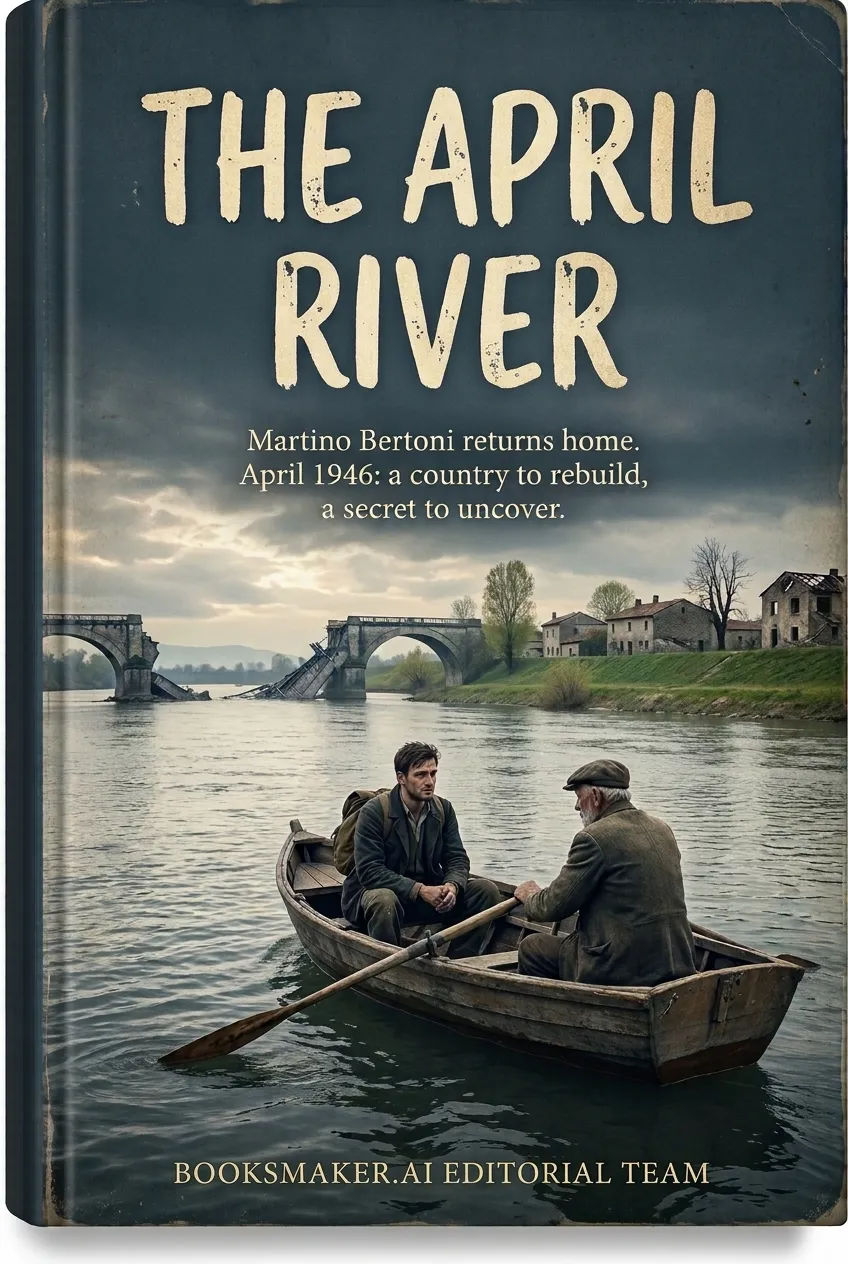
The April River
by Booksmakerai
English · Complete
Literary Fiction, Historical Fiction · Adults (26-64 years)
Aprile 1946. Dopo tre anni in Germania, Martino Bertoni torna al paese, dove tutti lo credevano morto. Il ponte è ancora distrutto e il fiume si attraversa in barca. A casa lo aspettano la madre, il padre e un posto vuoto a tavola: quello di Nando, il fratello partito per la montagna e mai tornato.
Martino riprende il lavoro nei campi, percorre le strade di sempre, cerca risposte. Ma in paese il nome di Nando si ferma sulle labbra: all’osteria, nei cortili, persino tra le mura di casa. Ciascuno sembra custodire una parte della storia, e ogni silenzio rende più urgente la domanda.
Con una scrittura sobria e attenta ai gesti quotidiani, Il fiume di aprile racconta il ritorno, il peso dei segreti e ciò che la guerra lascia nelle famiglie. Tra le arcate sommerse del ponte, i papaveri sull’argine e le mani impegnate nel lavoro, Martino cerca un varco per raggiungere il fratello e ritrovare il proprio posto.
English April 1946. After three years in Germany, Martino Bertoni returns to his village, where everyone believed him dead. The bridge is still in ruins, and the river can only be crossed by boat. Waiting for him at home are his mother, his father, and an empty place at the table: that of Nando, his brother, who left for the mountains and never came back.
Martino returns to working the fields, walks the same familiar roads, and searches for answers. Yet in the village, Nando’s name dies on everyone’s lips—at the tavern, in the courtyards, even within the walls of his own home. Everyone seems to be guarding a piece of the story, and each silence makes the question all the more urgent.
Written with restraint and a keen eye for everyday gestures, The April River tells a story of homecoming, the weight of secrets, and what war leaves behind within families. Amid the submerged arches of the bridge, the poppies along the riverbank, and hands busy at work, Martino searches for a way to reach his brother and reclaim his place.
First chapter
The Bridge in the Water
The driver braked before the bend. The truck jolted and Martino’s backpack slid against his feet. Damp air came in through the open window; until a little while ago it had carried the smell of freshly turned earth, now it smelled of water.
“You have to get out here.”
Martino picked up his backpack. The strap had got under one of his shoes, and he had to bend down to free it. The driver kept his hands on the steering wheel, waiting. Beyond the glass, the road ended against the sky.
“Can’t we get through?”
The man pointed ahead with his chin.
“Look.”
Martino opened the door. The running board was high, and before letting himself down, he felt with the toe of his foot. He touched grass, then earth. He turned to close the door, pressing twice to make the lock catch. Only then did he look at the river.
All that remained of the bridge entrance was the low wall beside the road. Beyond it there was nothing left for the eye to rest on: you had to lower your gaze to the water and then raise it again, to the opposite bank, where the road began once more. Two pieces of arch showed above the surface between them. The current uncovered them and covered them again, leaving a pale streak of foam on the stone.
They had told him the bridge had been blown up. He had nodded that time, without asking questions. Now he searched with his eyes for the parapet on the side where he used to stop as a boy, the stretch of paving worn smooth by wheels. He couldn’t place them in the water.
“The Germans,” the driver said. “Before they left.”
Martino adjusted the strap on his shoulder.
The engine missed a beat now and then. The man kept it going with his foot and leaned towards the door.
“You have to get to the other side?”
“I’m from over there.”
The driver looked back at the interrupted road. Then he nodded, as if that answer was enough for everything else too.
“You’ll find mud.”
“I can see that.”
“Not here. Further on.”
Martino nodded. He could have thanked him straightaway; instead, he waited for the man to turn the steering wheel. He moved away from the flattened grass, making room for him to manoeuvre, and raised a hand. The driver answered without looking at him. The truck backed up, straightened along the embankment and set off along the road they had come by.
Martino stood still until he could see it. The wheels left a fine dust on the potholes, which quickly settled in the damp air. When the truck disappeared behind the bend, the noise lasted a little longer. Beneath it, the sound of the water could be made out. Then there was nothing but that.
He set his backpack down between his feet. On his shoulder, freed of the weight, the strap’s pressure remained. There was no one for him to follow and no one had told him to wait; nonetheless, he waited. He became aware of what he was doing only when a gust of wind pushed the fabric of his trousers against his legs.
In the autumn of ’43, when they had taken him away to Germany, he had still tried to find out the time, the stops, how much longer there was to go. Later he had stopped. What remained of all that waiting was the way he stood: feet just slightly apart, hands empty, weight shifted from one leg to the other before the pain came. He did it there too, on the embankment of his village.
He bent to pick up his backpack.
The river was wider than he remembered. The snow melting in the mountains must have been swelling it for days: the water reached the grass and kept the lower blades bent. Where it met the remains of the bridge it gathered into tight lines, then spread out, brown, as far as the opposite bank. There were no workers or piles of stones to be seen. Almost a year had passed since the end of the war, and the road entrance still led nowhere.
A little further downstream, beside the old landing, there was a boat. The rope ran from the bow to a post driven into the bank. A man sat at the far end, his hat pulled down and his arm resting on his knee. The little smoke from his cigarette came apart in front of his face.
Martino looked for the path down. At first he couldn’t find it, because the grass had covered it; he recognised it by a fold in the ground, a lower line cutting across the slope. He put his foot sideways and tested whether it would hold. The earth gave way just a little beneath his heel.
A few steps away there were poppies. One had a bent stem and its flower turned towards the ground; the others stood upright in the grass, shaken by the same wind. Martino stopped without lowering his backpack. He couldn’t remember the last time he had looked at one up close. There might have been some in Germany. He wouldn’t have known.
He waited for the bent flower to stop moving. Beneath the red edge he could see the black of the petals gathered at the centre. Then he started down again, choosing the places where the earth showed through. The grass brushed against his trousers and water seeped into the seams of his shoes. Further down, the old man was still smoking. He hadn’t turned his head yet.
At the bottom of the slope, the path opened onto the gravel. Martino took the last few steps more quickly, carried along by the incline, and stopped near the post. The taut rope creaked each time the boat moved a foot away from the bank. On its return, the edge struck a flat stone and made a dull thud.
The old man turned his head. Beneath his straw hat his forehead was dark, crossed by lighter wrinkles. The brim was broken, and a few strands brushed his ear. He looked at the backpack, then at Martino’s shoes; finally, he looked at his face.
“Could you take me over?”
The old man took the cigarette from his lips.
“It costs twenty lire.”
Martino let the backpack slide down to the crook of his elbow so he could search his pocket. There was no need to count, but he did it anyway, keeping the coins safe in his fist. He had counted them before getting on the truck. He knew their weight.
“Ten. I don’t have any more.”
The old man put the cigarette back in his mouth and held out his hand. Martino hesitated for another moment.
“Will that do?”
The man opened his fingers wider.
“If you’ve got ten, give me ten.”
He took them without moving from the bench. With his thumb he slid them across his palm, one over the other, accompanying the count with a movement of his lips. Then he put them in his shirt pocket and passed his open hand over it.
Martino stayed beside the post. The empty pocket clung to his leg. There was no one else on the bank; he looked towards the road almost to make sure they weren’t supposed to wait for someone. The old man made no move to set off. He had rested his arm on his knee again and was studying him, cigarette between two fingers.
Martino kept his face raised. His beard had grown for days, and he could feel the skin pulling over his cheekbone, where the wind had dried it out. He felt like running a hand over his badly cut hair, but left his arm where it was.
“Bertoni,” said the old man.
It didn’t sound like a question. Martino nodded.
“The younger one.”
“Martino.”
The man moved his head just slightly, repeating the name without a sound. His eyes returned to the scar above Martino’s eyebrow, then moved down to his cheeks. Martino waited.
“I thought you were dead.”
A louder sound came from the river. The water had hit the side and the boat had shifted, pulling on the rope. The old man glanced at it, as he would have if they’d been talking about the weather.
“I’m here,” said Martino.
“Eh.”
The old man took his last drag on the cigarette. He looked at the tip, then put it out by pressing it against the wood. He had to keep at it so the tobacco wouldn’t stay lit. When he was done, he leaned towards the rope.
Martino didn’t ask him who else thought he was dead. The answer had already reached the village, passed from one door to another while he was still on his way back. There, beside the post, there was no one who needed to be told. The old man was loosening the knot with his fingernails and holding the boat steady with his foot.
“Get in at the front. Not on the edge.”
Martino put his backpack in the bow, then leaned on it to climb in. The boat tilted. He stopped with one foot still on the gravel until the old man pulled it closer. Once inside, he went to sit on the indicated bench. He held the backpack between his knees, the two straps facing him.
Beneath his fingers, the wood had a soft surface, smoothed by use. Where the old man’s hand passed less often, raised splinters and dark clumps of tar remained. The smell rose mostly from the bottom: old, damp tar, and something fishy the river couldn’t wash away. There was a trickle of water between two planks. Martino put his sole over it so the backpack wouldn’t touch it.
The old man gathered the rope into broad loops. Then he stood, helping himself with one hand on his knee. He remained bent for a moment before straightening his back; he took the long oar and pushed it against the gravel.
The hull barely moved.
Martino started to get up.
“Stay where you are.”
The old man shifted the oar’s position, planted one foot and pushed again. This time the bottom scraped over the stones for a long while. Water slipped between the bank and the boat, first in a narrow strip, then wide enough that Martino could no longer step across it. He sat back down properly.
The bow turned. For a while it seemed they were heading towards where the river ran fastest; the old man dipped the blade and held it there, resisting with the weight of his body. The boat changed its tilt and set off across the river.
Martino watched the post recede. Seen from the water, it was lower, just a piece of wood driven into the mud. Behind it, the path was lost at once in the grass. He thought again of the place where he had waited after the truck left: from the boat, it was already impossible to make out.
Now that it no longer touched bottom, the oar moved without a sound. The old man dipped it on the same side and let the water press against the blade; then he lifted it, shifted it a little and began again. The work showed in his shoulders, not his hands. Martino watched them for a while. With each adjustment, the bank ahead changed position behind the old man’s hat.
A long branch passed beside the bow. Clumps of grass still clung to it, and it turned slowly, showing first its dark bark, then its broken wood. Martino drew one hand back from the side, though the branch was too far away to hit him.
“Where are you coming from?”
The old man said it without turning around. Martino waited until he had lifted the oar.
“Germany.”
“All the way here with that?”
He gestured towards the embankment, towards the truck that was no longer there.
“The last bit. Before that, the train, as far as Bolzano. Then however I could.”
“Walking.”
“Sometimes.”
The old man nodded and went back to his work. He didn’t ask how long it had taken. Martino spread his fingers on the wood. He had prepared himself to reconstruct the journey, to give the names in the right order, to explain the stretches he couldn’t explain even to himself. Those few words were enough.
The boat entered an area of stronger current. The surface of the water was all streaked; in some places it seemed still, but the straw passing over it hurried away. Martino watched the bank to make sure they were moving forward. Poplars grew along that side in an almost unbroken row. At one end, where the trees opened up, a house without a roof appeared.
The inside of the upper floor was visible. A beam remained propped at an angle, black against the sky; lower down, a stretch of plaster still held the colour of a room. In front of the house, a man was pushing a wheelbarrow. He stopped when he saw them and stood with his arms extended over the handles. Then he took one hand off and raised it.
The old man answered by raising two fingers. Martino didn’t move. Before he could decide whether that greeting included him too, the boat had already passed by. He watched the roofless wall for a little while longer, until the brim of the old man’s hat hid it from view.
“Are they waiting for you at home?”
“They don’t know anything.”
“Your father doesn’t know?”
Martino shook his head.
The old man pressed down on the oar. The wood made a short sound against the oarlock.
“Maybe that’s better.”
He said nothing more. Martino watched the line of his shoulders beneath his shirt. He could have asked what he meant, whether it was better for him or for his father. Instead, he bent to adjust the backpack, which had shifted between his knees.
Further out, a barrel was passing. It was lying on its side and turning slowly, with one hoop emerging from the water and then disappearing. Martino followed it until the old man blocked it from view too. When the oar came back into the air, a few drops fell onto the bench.
In October, before he was taken away, the drops had landed on his face.
They were in a borrowed boat and couldn’t see the banks. Nando had lifted the oar too high, laughing, and water had gone everywhere. Martino had protested more loudly than necessary. He still remembered the wet jacket across his knees and the way he tried to keep his feet in the middle of the bottom, away from the sides.
The fog covered the river to within a few feet of the boat. It was impossible to know whether they were moving: a patch of water disappeared in front and an identical one appeared behind. Nando rowed in jerks. Between strokes he turned towards Martino and laughed at his face, or at something his face had put him in mind of.
“You can look at me all you want,” Martino had told him. “Just keep rowing.”
His brother had put the oar down again. But he was still laughing, and the blade had gone in crooked, bringing more water inside. Martino had pulled his feet back. Then Nando had stopped altogether.
The boat had been left at the mercy of the current. There wasn’t even that clumsy movement any more to show that someone was taking them somewhere. Martino had stretched out a hand towards the oar; Nando had kept it out of his reach, still watching him.
“Now you find the bank.”
Martino had turned around. There was the same fog on every side. He had heard his brother laugh louder and, when he turned to look at him again, he had started laughing too. He had laughed, holding on to the bench, his knees pressed together, still waiting for Nando to take up the oar again.
The old man scraped the wood against the side. Martino looked up.
The poplars were ahead. The bank was clear; he could make out the tufts of grass separated from the earth that had slumped away. There was no fog and no one sitting beside him. He moved his hands from the bench to the backpack straps. He had gripped the wood for so long that a line remained on his palm.
He looked at it and ran his thumb over it. He waited for the mark to return to the colour of his skin. The old man kept moving the oar, and Martino counted two strokes, then a third, before he was able to look at him again.
“Nando,” he said.
The old man didn’t turn around. The blade plunged and disappeared into the muddy water. For a few moments Martino thought he had spoken too softly; he could still feel the name in his mouth, but didn’t know whether it had reached the stern.
“My brother,” he added.
“I know who he is.”
The old man lifted the oar. Water dripped from the tip, leaving a series of dark spots on the bottom. Now the boat was moving almost straight and the current no longer pulled it as it had before.
Martino waited. The old man was looking towards the bank, not at him. A blackbird was moving among the lower branches of the poplars; he could hear it, but couldn’t see it. He lowered his gaze to the stretch of water between his shoes and the side.
“He went up into the mountains,” the old man said at last. “In ’44.”
“I knew that.”
The old man nodded, but it didn’t seem as if that assent was leading to any more words. He turned the oar just a little, let it slide along the side of the hull and wiped his wet fingers on his trousers.
“And after that?”
Martino had asked in the same voice he had used to ask the price. He realised this and straightened on the bench.
The old man lifted the oar until the blade was completely out of the water. He looked at its edge, where the wood had lost its colour. The boat continued on its own.
“Your father will be there.”
“I wanted to hear it from you.”
“You can ask your father.”
The sound had changed on that side. The broad river remained behind the stern, while ahead, beneath the trees, the water moved in slow folds. Martino heard the blackbird again, closer this time. He realised he was waiting for that call to end too.
“It’s not for me to say,” the old man said.
Martino looked at the shirt pocket where his coins had gone. A diagonal crease remained in the fabric. A little while ago that man had agreed to take him across without asking him anything; now he held the oar raised and waited for him to stop.
“All right.”
The old man dipped the blade again.
“It’s hard, Bertoni.”
Martino looked up.
“I know him.”
“You’ll talk.”
He didn’t answer. The bank was so close that he could make out the stones beneath the surface. The old man felt for one with the oar, tested the bottom and pushed. The hull turned slowly, presenting its bow to the gravel shore. Martino loosened his fingers on the backpack straps.
He had prepared himself to recognise faces, streets, a door. He hadn’t thought he would have to wait for his father to learn something about his brother. He tried to imagine the question in front of him, standing, with no river to cover his voice. He stopped before finding the words.
The boat struck the gravel. The blow travelled from the soles of his feet to his knees. The old man set down the oar and moved to the bow, keeping low so as not to unbalance the hull. Martino drew his legs back to let him pass.
The man rolled up his trousers and stepped into the water. It came up to just below his knees. He grabbed the bow and walked backwards, stopping at every step to get a better grip. The boat scraped over the stones with a long rasp. When the old man let go, it stayed still.
“Now.”
Martino lifted his backpack. He put one hand on the side, shifted his weight and felt for the bottom with his foot. Water immediately came through the gap in his sole. Cold, it slipped beneath his toes; as he set down his other foot too, he felt his heel getting wet.
He stayed in the water for a moment to give the old man room to return to the boat. A stone rolled beneath one shoe and he had to shift his footing. He waited for the mud stirred up by his step to disperse. He found a wider stone, tested it with the tip of his foot and shifted his weight onto it, holding the backpack high against his side. Then he reached the dry gravel, where a little water ran out of the broken leather of his shoes with each step.
The old man picked up the oar again and laid it on the bottom, making sure it didn’t stick out. He bent to gather the rope. Up close, Martino could see the marks the collar had left on his neck, lighter than the exposed skin.
“Thank you,” Martino said.
“You paid.”
“Only ten.”
The man pulled the rope towards the post.
“You had ten.”
Martino nodded. He watched him as he looped the rope around the wood, tightened it and prepared another loop. He felt like helping him, but the old man’s hands had already finished. There was nothing to hold.
He put both straps over his shoulders. He adjusted the right one, which had twisted, and took a few steps on the gravel. When he turned around, the old man was still by the post, watching to see whether the knot held against the boat’s pull.
Martino raised a hand slightly. The man answered with his chin. Behind him, the water flowed past without stopping at the landing; further away, a strip of straw had gathered against a branch and came loose just as Martino turned to look for the path again.
The path began behind a clump of flattened grass. Martino went in slowly. On the gravel he could put his feet down however he liked; on the sloping earth, he had to choose where to put them. The open sole bent against the clods and let in mud. After a few steps, his toes no longer felt the cold of the water, only the weight of his wet sock.
He climbed, watching the ground close by. A section of the slope had slipped and the path narrowed: he put his hand on the grass, found earth beneath the roots and pulled himself up. The backpack slid off one shoulder. He didn’t put it back in place until the ground became less steep.
He stopped halfway up, where a small rise made it possible to stand with both feet level. From below came the sound of the rope against the side of the boat. The old man had sat down and was doing something with his hands, perhaps looking for his tobacco. Martino couldn’t make it out. He looked at the place where he had paid and the place where he had got out: now they were visible on the same side of the river, joined by a strip of gravel.
He caught his breath without opening his mouth. He didn’t want to reach the top panting. He had walked farther in the previous days, with fewer stops, yet he had to wait for the pulse in his neck to slow. He pulled his collar open with two fingers. There was a rough seam rubbing against his skin, always in the same spot.
From there he still couldn’t see the village. He could see only the sky above the ridge and, to one side, part of the row of poplars. Martino watched their tops bend. Then he adjusted his backpack and covered the last stretch.
At the top, the wind hit him in the chest. The road ran along the embankment, with two pale ruts and grass in the middle. On the other side, a narrower lane sloped down towards the fields. Martino recognised it before he could see where it ended: there was the bend it made to follow the edge of a field, then it straightened out again all the way to the canal.
The village lay beyond the still water, among the poplars. He hadn’t seen it during the crossing, hidden by the bank and the trees. Now he could follow the rooftops, one after another, from the lowest one near the fields to the church. Some had lighter tiles; on others, hollows could be made out which, from that distance, might have been shadows. He looked for the bell tower and for a moment he looked too high.
It ended lower down.
He lowered his eyes to the remaining top, flat and dark against the sky. He tried to reconstruct the point with its roof, the shape that had allowed him, as a child, to find his way back from the fields. He managed it for only an instant. The cut edge of the wall remained there, and each time it made him start counting the houses again.
He started from the church. The first, the second; at the third, he stopped.
The roof of his house was lower than the one next door. From where he stood he couldn’t see the courtyard, but he could see the chimney. A thin thread of smoke came out of it, rising straight for a little while before the wind bent it. At times it disappeared against a pale wall, became visible again above the roof tiles and came apart.
Martino let his arms fall. Throughout the journey he had had something to hold on to: a strap, a door, the edge of a bench. Now his hands rested open against his trousers as he watched that little thread of smoke.
Someone had lit the fire. They had taken the wood, stirred the ashes, blown where they needed to. His mother might be nearby, bent over, her apron pulled to one side. He didn’t see her standing there waiting for him, but occupied with a task that had to be finished. He tried to call to her without a sound. His mouth didn’t move.
He shifted his gaze to the fields. His father might still be outside. From that distance, people couldn’t be made out, but Martino searched all the same, pausing over the darker patches of earth. His father’s hat came to mind, the way he took it off when he went in, holding it by the brim with two fingers. Would he still have the same hat? The question seemed foolish to him; he looked back at the chimney.
The smoke continued to come out. No one knew that he was watching it. His mother might turn towards the window just then and see nothing, because the embankment was far away and he stood still among the grass. He took half a step forward, then stopped before the slope began.
The old man’s words came back to him without his voice: his father would be there. Martino moved his jaw, as if to rid himself of a taste. He looked again at the houses on either side of his own. They too had an entrance, a hidden courtyard, someone inside. He didn’t know where to begin thinking about the people. But he could recognise the rooftops and follow the canal water as far as it disappeared among the trees.
The light had lowered. It struck the walls from one side and left the other in shadow. There were still poppies in the grass near the path, but Martino didn’t bend down to look at them. He followed the road with his eyes as far as the bend, then from the bend to the canal. He travelled along it that way once, without moving.
A distant bell began to ring. He didn’t count. He simply waited for the chimes to stop, while a gust of wind chilled his feet inside his shoes.
He pulled up the left strap. He took hold of the right one near his shoulder and gripped it tightly. Before moving, he looked back at the chimney: the wind had changed direction and now the smoke stretched out over the neighbouring roof.
Martino put his foot at the beginning of the path. He tested the earth with his heel, shifted his weight forward and began to descend towards home.