How to Write a Plot Twist That Feels Inevitable
How to write a plot twist that surprises readers without cheating them: twist types, foreshadowing, red herrings, and the three-clue method with a worked example.
Stay updated with our newsletter
Receive exclusive tips, resources, and updates to turn your ideas into bestselling books.
The most reliable way to write a plot twist is to start from the reveal and work backwards: decide what the reader will discover, then plant the clues that make that discovery feel inevitable. The first shock lasts a page; the coherence lasts the whole second read.
A plot twist is not an accident that happens at the right moment. It is a piece of information the text has already given, hidden in a place the reader was not looking. When the reveal arrives, every earlier scene has to keep working and take on a more precise meaning. If the twist only works when the reader forgets what they read, the problem is not the surprise: it is the construction.
This guide moves from twist types to a practical five-step method, the three-clue method, with a worked example and numbers you can check. You will also find where to place the twist in the manuscript, the mistakes that turn it into a con, and how Books Maker can help you test it before the final revision.
Table of contents
- Key definitions
- Why plot twists work
- The five types of plot twist
- How to write a plot twist: the three-clue method
- Where to place the plot twist
- Five mistakes that ruin a twist
- How to test a plot twist with AI
- Frequently asked questions
Key definitions
Narrative theory uses different words for closely related effects. Fixing the terms avoids the most common confusion, the one between a twist and a turning point.
Plot twist: a reveal or event that changes the meaning of what the reader has already read. It does not necessarily change the direction of the plot.
Peripeteia: a sudden reversal of the protagonist's fortune. Aristotle describes it in the Poetics alongside anagnorisis, and treats it as one of the devices that produce pity and fear (Poetics, Wikipedia).
Anagnorisis: a sudden recognition of a hidden identity, either one's own or someone else's. It is the oldest type of plot twist in the Western tradition.
Foreshadowing: an indirect anticipation of a future event, built with details that only make sense after the reveal.
Red herring: a false clue deliberately planted to push the reader toward the wrong explanation.
Unreliable narrator: a narrative voice that reports events incompletely or in a distorted way. The reader learns the truth with the protagonist, or after.
Why plot twists work
A twist works on the gap between what the reader knows and what the reader thinks they know. The text supplies an accurate piece of information but places it in a context that suggests a different interpretation. The classic example is a conversation in which two characters discuss "the accident" for three chapters: nobody ever says it was an accident, yet the reader assumes it.
The second ingredient is emotional stakes. If the reveal changes nothing for the characters, the reader files it away as a detail. If it changes a relationship, a grief, a sense of guilt, or a choice already made, the twist produces consequences. The question is not "is this ending surprising?" but "what does the protagonist have to redo after learning this?".
The third ingredient is rereadability. A good plot twist improves the book on a second read, because earlier scenes show a second layer. That is the standard demanding readers apply, and the reason some twists age well while others feel like tricks. Agatha Christie's The Murder of Roger Ackroyd remains a textbook case: the solution does not add a character, it repositions the narrator.
The five types of plot twist
Twist types differ in what they reveal and in the moment where they work. The table compares the five most common ones against three criteria: what changes for the reader, which genre they suit best, and the risk they carry.
| Twist type | What changes for the reader | Works best in | Main risk |
|---|---|---|---|
| Anagnorisis | A character's identity | Tragedy, gothic novel, family saga | Feeling like a serialized melodrama device |
| Betrayal | The trust placed in an ally | Thriller, spy story, drama | Making the character incoherent |
| False protagonist | The center of the story | Horror, thriller, series fiction | Making attached readers feel cheated |
| Unreliable narrator | The reliability of the whole account | Noir, psychological, literary fiction | Forcing a mental rewrite of the book |
| Retroactive reveal | The meaning of events already read | Mystery, science fiction, magical realism | Revealing the surprise with no consequences |
The choice depends on genre, but also on the promise made to the reader in the first pages. A novel presented as a classic mystery can afford an anagnorisis; a fictional memoir can afford an unreliable narrator, because the initial pact is already suspended. Trouble starts when the type of twist contradicts the promised genre, not when it surprises.
There is also a dosage question. A false protagonist can be used once per book; a betrayal can repeat if every betrayal serves a different function. A retroactive reveal, by contrast, spends a lot of the reader's energy: asking them to reinterpret everything twice is asking a lot, and it should only be done if the second meaning is stronger than the first.
How to write a plot twist: the three-clue method
This is the system I use to check a twist before writing the reveal scene. It does not promise that the twist will be original, but it prevents it from being arbitrary. It works for novels, short stories, and screenplays, with an adjustment for short fiction.
Step 1: state the reveal in one sentence
One sentence with three elements: who hides what, from whom, and why. If you cannot write it in one line, the reveal is still confused. Example: "Elena discovers that her brother died on the pier two years ago and that her mother has hidden it from everyone, including her."
Step 2: plant three clues through three different channels
Three clues in the same channel are too loud a signal. Distribute them like this:
- Action: a behavior the character never explains. The brother never sits at the table, yet his plate is always set.
- Dialogue: a true but ambiguous line. The mother says "when he comes back we'll fix the boat," and nobody corrects her.
- Physical detail: an object, a time, or a place that keeps returning. The pier clock is stuck at 9:40 in three different scenes.
Each of the three must be true, verifiable, and compatible with the false explanation. An attentive reader can notice them, but has no reason to connect them before the reveal.
Step 3: add one false clue that is more visible
The red herring must attract more attention than the three clues combined. In the example, a late-night phone call that Elena attributes to her brother, while it is a creditor calling her mother. The false clue does not lie: it is a real piece of information the protagonist misreads. If the red herring requires the narrator to lie, it is not a red herring, it is a con.
Step 4: place the reveal and count the consequences
In the example the reveal lands at 68% of the novel, followed by two scenes about what changes afterwards: the mother stops setting the plate, Elena rereads the last two years, the father admits he stayed silent. The number is not a rule, but it forces you to plan space for the consequences. A twist without consequences is fireworks.
Step 5: apply the second-read test
Reread the scenes containing the clues while pretending you already know the truth. If every scene still works, the twist holds. If a scene requires the narrator to withhold information they know, the construction needs rebuilding. If the protagonist could not have noticed at least one of the clues, the twist is too well hidden.
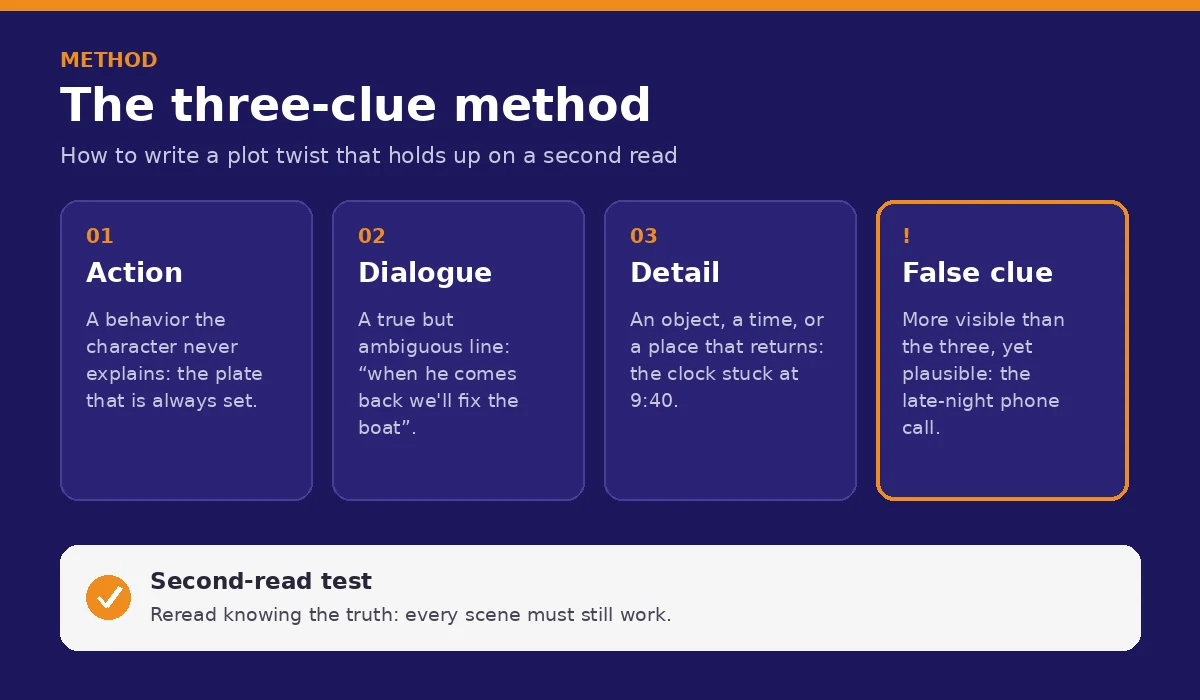
The pier house example was built for this article; it does not come from a published novel. It shows the relationships between the elements: three true clues, one plausible false clue, two consequence scenes. Apply the same scheme to your manuscript and you get a control grid you can fill in ten minutes. If an element is missing, you know exactly where to intervene.
Where to place the plot twist
Placement depends on the twist's function, not on personal taste. Four positions cover almost every case:
- 25%: an early twist that changes the direction of the story and opens the second act. It proves that nothing is safe.
- 50%: the reveal that shifts the conflict, typical of three-act structure. The protagonist discovers they have been fighting the wrong person.
- 60-75%: the main twist, the one that reinterprets events already read. It leaves room for consequences and crisis.
- 85-90%: the reveal that solves the mystery. It only works if the consequences have already been told or the book has a sequel.
A common mistake is placing the most important twist in the last five pages. At that point the reader has no time to see what changes, and the reveal stays a piece of information. If the twist is really the heart of the book, it has to arrive before the book ends. The question of how to write a plot twist is therefore also a question of when to let it land.
Five mistakes that ruin a twist
Most failures in how to write a plot twist come from one of these five habits. Each one breaks the agreement between text and reader in a different way.
- Hiding information the narrator knows. This is the line between surprise and deception. An unreliable narrator can do it, but only if the text has established what kind of voice is speaking.
- Solving everything with an element introduced at the end. The modern deus ex machina is not a god lowered from the sky; it is a character or a document that appears in the final chapter.
- Using the twist to erase the story. "It was all a dream" does not reinterpret events, it cancels them. The reader feels robbed of the pages they read.
- Stacking too many twists. Beyond three major reveals, each new discovery devalues the previous one and the reader stops investing emotionally.
- Forgetting the consequences. If characters behave as before after the reveal, the twist carries no narrative weight. The truth has to cost someone something.
How to test a plot twist with AI
Books Maker is useful in the stages where you need a reader who does not know your story. You can ask it to list the possible interpretations of a scene, to point out which clues are too visible, and to check whether the reveal is compatible with every chapter. A useful prompt is: "Read these three scenes and tell me which alternative explanations an attentive reader might form. Do not suggest my solution."
AI also helps generate variants. Ask for five versions of the same reveal, then choose the one that needs the fewest explanations. If a version needs a paragraph to be understood, it is not ready. For overall structure, pair this work with the book outline and Freytag's Pyramid, which help you see where the turn falls in the story.
For genres built on tension, the techniques in our thriller guide and the guide to endings readers remember complete the picture. A twist is not a genre: it is a device whose effect changes depending on where you put it.
Frequently asked questions
How do you write a plot twist without cheating readers?
Leave at least three verifiable clues in the text before the reveal, and never hide information the narrator knows. Readers accept being surprised, not being tricked: after the twist they should be able to go back and find the traces they overlooked.
How many plot twists does a novel need?
One main twist and two or three secondary ones are enough for a 300-400 page novel. Beyond that, readers stop trusting the story, because each new reveal devalues the previous ones. Tension can also be sustained with open questions and small mysteries.
Where should the main plot twist go?
Between 60% and 75% of the manuscript if the twist must change the meaning of what has already happened. If it solves the mystery instead, place it between 85% and 90% and leave room for the consequences. A reveal in the last five pages has no time to produce effects.
What is the difference between a plot twist and a turning point?
A turning point changes the direction of events; a plot twist changes the interpretation of events the reader has already seen. They often coincide, but not always: a betrayal can be a turning point without a twist, and a revelation about the past can be a twist without changing the immediate action.
How do you avoid deus ex machina?
Make the solution or revelation grow from elements already present in the story. If the ending needs a character, an object, or a piece of information introduced at the last minute, the twist is a device. Every decisive element of the ending should appear at least twice before.
Can a predictable plot twist still work?
Yes, if readers can see what is coming but not what it will cost. Surprise is not the only available emotion: anticipation, dread, and the wish to see how characters react can carry entire chapters.
Conclusion
A credible plot twist comes from work the reader never sees: the reveal written in one sentence, three clues through different channels, a more visible false clue, space for consequences, and a check on the second read. These are five checks, not five rigid rules. They separate a twist that holds from one that only holds on effect.
The next time you write a surprise ending, fill in the grid before writing the scene. If a clue is missing, you still have time to add it. If a consequence is missing, the problem is not the twist: it is the story that gave it nowhere to land.
Keywords: how to write a plot twist, plot twist, fiction, story structure, clues, foreshadowing, red herring, anagnorisis, peripeteia, unreliable narrator, second read, turning point, deus ex machina, thriller, mystery, novel, ending, revision, Books Maker
About Books Maker: Our team is made up of AI professionals. Together with expert writers and authors, we created booksmaker.ai to help our users achieve their publishing dreams by leveraging the power of Artificial Intelligence tools for every stage of the process, from idea to book creation.
Related articles
- How to create a book outline
- Freytag's Pyramid: five-act story structure
- How to write a thriller
- How to end a book
- POV switching in a novel
More questions? Visit our complete FAQ on creating books with Books Maker for answers on features, pricing, and publishing.
Share this article
Start creating your book with AI
Use Booksmaker.ai to turn your idea into a published book, chapter by chapter.
Start for free